

Last week, IndiGo, India’s biggest airline, ordered 810 Airbus jets. What most people missed is that they also chose Honeywell Aerospace to provide the cockpit electronics, weather radar, collision-avoidance system, and the small tail engine that powers the plane while it’s at the gate.
Many see this as just a huge sale. But it’s actually a 30-year stream of income. Understanding this helps explain a whole group of great businesses that most investors overlook.
Here’s how it works. Once a part is installed on a certified aircraft, it stays there. Replacing it would mean repeating all the safety approvals, which takes more time and money than the part itself. This means the supplier keeps the contract for the plane’s entire life, which is about thirty years. Every service, spare part, and software upgrade over those years goes back to the same company, often at much higher profit margins than the first sale.
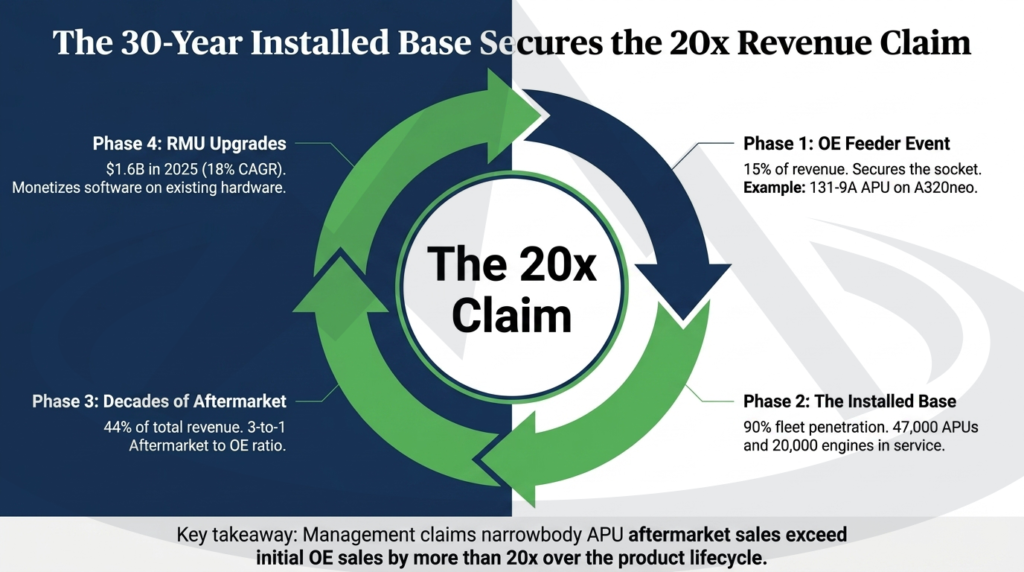
How much better are the margins? According to management, servicing just one of those tail engines can eventually bring in more than twenty times its original sale price. We can’t confirm this from public records, so we treat it as their claim. Still, the pattern is clear: servicing and spare parts already make up 44% of the company’s revenue, while new equipment sales are only 15%. That’s three dollars of servicing for every dollar of new equipment.
It’s like the classic razors-and-blades model, but at 35,000 feet. Sell the plane once, then keep selling the parts and services until 2056.
There’s another part of the business that gets even less attention. The company also sells software upgrades for planes that are already in service. For example, Aeromexico recently agreed to add a runway-collision warning system to over 100 of its jets, and it works as a software update to equipment that was installed years ago.
So is this a perfect business that everyone should invest in? Not exactly, and this is where things get tricky. We rated this company across fourteen different categories. It scored as durable, but not outstanding, and its weaknesses aren’t where most people would expect. In fact, two of them are right in the middle of the growth story that has everyone excited.
What does this mean for you? When a supplier lands a big order, don’t just focus on the size of the sale. Ask how long they’ll keep getting paid after the sale, and whether the customer could actually switch to someone else. That answer is often more important than the headline number.
The full 14-point scorecard, including the four categories where we marked this business down, is in our Special Edition report at https://moatpeak.com.
Educational research only. Not personalised investment advice. MB “MoatPeak Group”.
Get the Weekly Explainer
The biggest market story explained, every week. Free, by email.
Explore the research library
Company, industry and market reports with sources, charts, possible outcomes and the full evidence.
More free explainers
Markets, companies, portfolio basics and investing foundations. All free articles.
Back to Learn