

Somewhere between the refinery and the checkout, US companies are absorbing a cost shock.
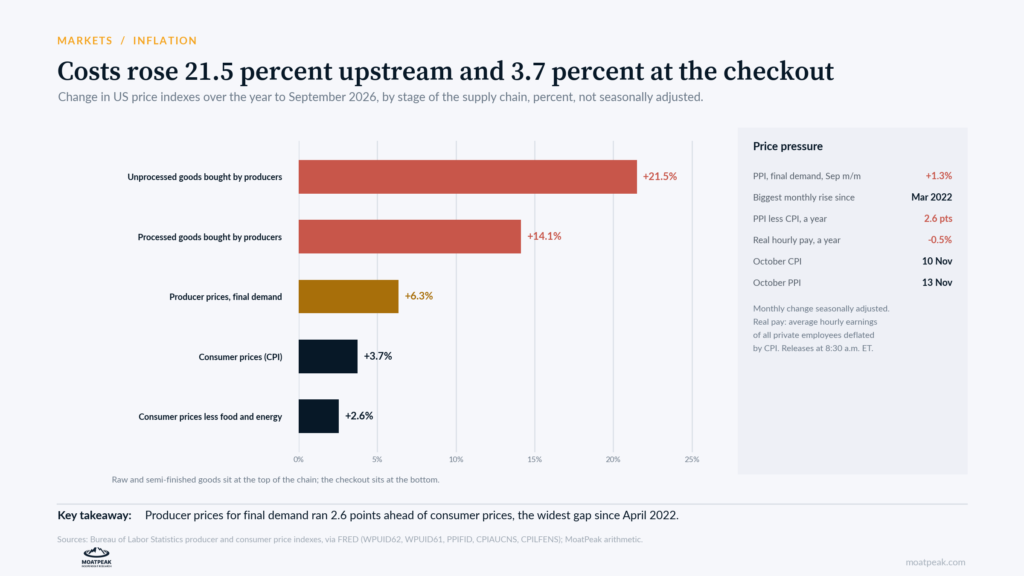
In the year to September, prices of unprocessed goods bought by producers rose 21.5 percent, and prices of processed goods rose 14.1 percent. Producer prices for final demand rose 6.3 percent and consumer prices 3.7 percent. The 2.6-point gap between the two is the widest since April 2022. It has opened while after-tax corporate profits stand at a record 13.1 percent of GDP, against an average of 7.4 percent since 1947.
Who pays for the gap
When producer prices run ahead of consumer prices, someone along the chain absorbs the difference. Usually it is the company that sells to the household, because the household’s budget sets the limit. September made that harder. Producer prices for final demand rose 1.3 percent in the month alone, the most since March 2022. Meanwhile, average hourly earnings, adjusted for inflation, were about 0.5 percent lower than a year earlier.
That makes the gap a test of pricing power, and third-quarter reports already show both outcomes. Cummins widened its margins in three of its four main businesses. GEICO, Berkshire Hathaway’s car insurer, saw claims costs climb while average premiums per policy fell, and its underwriting profit dropped 45 percent.
What history says
We marked every quarter since 1948 in which producer prices for all commodities rose at least 4 points faster than consumer prices over the year. Those quarters fall into six episodes before this one. In four of them (1950 to 1951, 1973 to 1974, 2007 to 2008 and 2021 to 2022), the profit share of GDP fell by at least a point within two years. In the other two (2003 to 2005 and 2010 to 2011), it held.

The gap was rarely the only factor. Recessions did much of the damage in 1974 and 2008. The closest match to now is 2021 to 2022: a commodity-driven shock, a profit share near its record, real wages falling and the Fed raising rates. Even without a recession, the profit share slipped 1.1 points.
Our read
We read the gap as an early warning for margins in 2027 more than for the next quarter. Costs travel down the chain with a lag, and companies try price increases, a richer product mix and cost cuts before margins give. But real pay is already falling, which leaves less room to push prices than when incomes are growing. A one-point drop in the profit share from 13.1 percent would cut aggregate profits by about 8 percent relative to the economy. For a market priced on record margins, that is a real headwind, and it would land hardest on companies without pricing power.
The case against us
Much of the pressure comes from energy. If oil prices keep falling, upstream costs can reverse quickly. Producer price inflation for final demand fell from almost 12 percent in March 2022 to 0.3 percent by June 2023.
The companies that drive index profits also sell chips, software and power equipment into an investment boom, where pricing power is strong. The profit share also includes energy producers, whose profits tend to rise in these episodes.
What it means for your money
- Read the margin line first. Gross margins that held while input costs rose are the clearest sign of pricing power.
- Sort holdings by their place in the chain. Companies that buy commodities and sell to stretched households are the most exposed. Those with contracted, regulated or cost-plus prices are the least.
- Size the downside. A one-point fall in the profit share is about an 8 percent hit to aggregate profits relative to GDP. Falls as large as those of 1952 or 2008 would cut aggregate profits by 27 to 34 percent.
What we are watching
- October consumer prices, 10 November: whether shelf prices start to catch up with producer costs.
- October producer prices, 13 November: whether the increases at the start of the chain are still accelerating.
- Fourth-quarter guidance: whether companies say their price increases are sticking as input, freight and energy costs rise.
Educational research only. Not personalized investment advice. MB “MoatPeak Group”.
Get the Weekly Explainer
The biggest market story explained, every week. Free, by email.
Explore the research library
Company, industry and market reports with sources, charts, possible outcomes and the full evidence.
More free explainers
Markets, companies, portfolio basics and investing foundations. All free articles.
Back to Learn