


CoreWeave rents out computing power for artificial intelligence from data centers it runs. On 10 November, it reported revenue of $3.66 billion for July to September, up 168 percent from a year earlier. Its backlog, revenue from signed contracts not yet delivered, stood at about $132.5 billion. The shares closed at $48.73 before the report.
The growth is expensive. CoreWeave posted a net loss of $709 million for the quarter, and its debt has more than doubled this year.
Where the cash came from
Operating cash flow was $1.98 billion. That figure includes a $2.13 billion rise in deferred revenue, cash that customers paid before receiving the service. Without those prepayments, operating cash flow would have been about $150 million negative.
Spending was far larger. CoreWeave spent $9.44 billion on equipment, data centers and software in the quarter. It borrowed $10.30 billion and repaid $2.34 billion.
What the debt costs
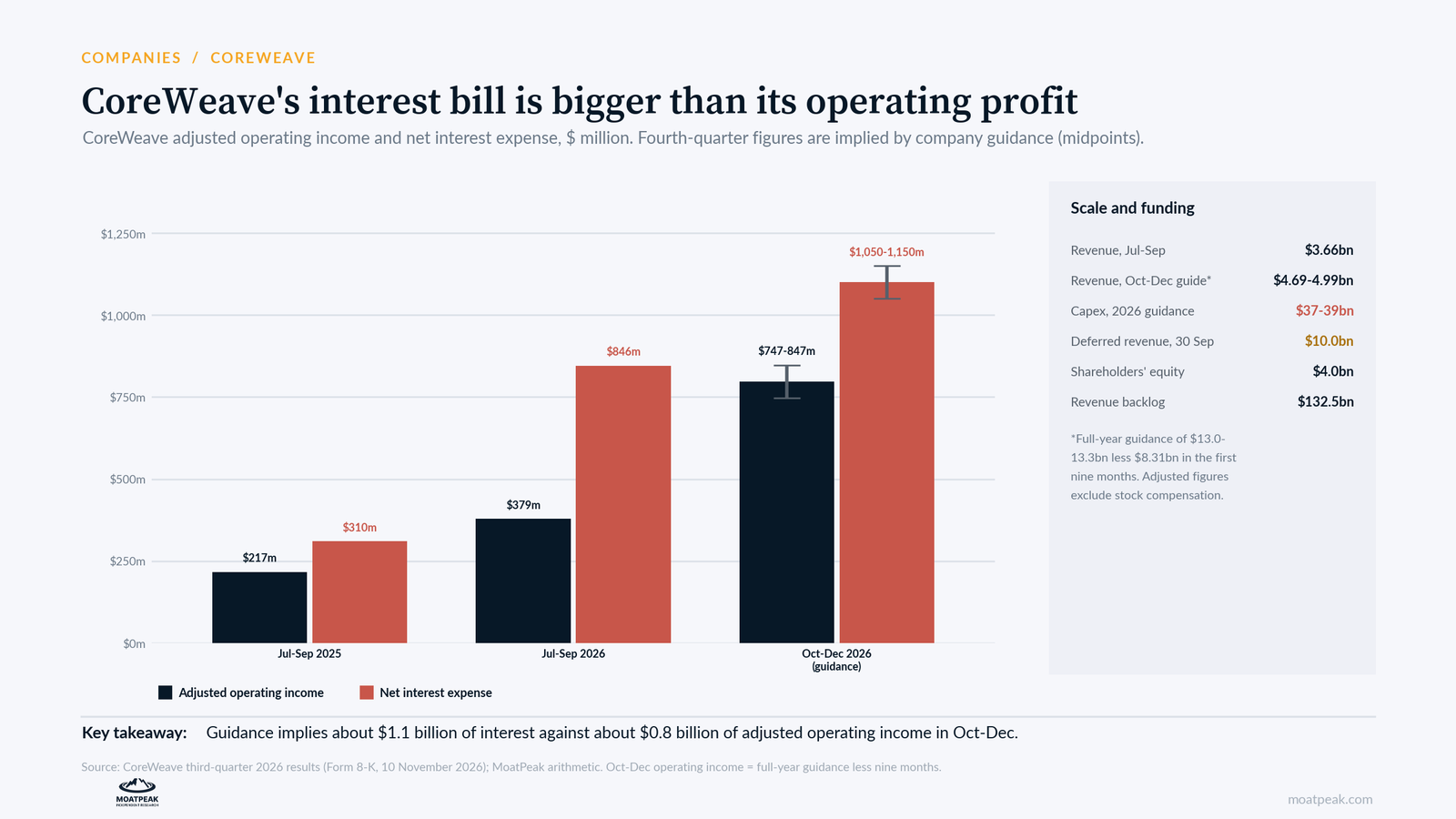
Total debt reached $46.9 billion at the end of September, up from $21.4 billion at the end of 2025. Net interest expense was $846 million in the quarter, against $310 million a year earlier.
That bill is now larger than the operating profit. CoreWeave’s adjusted operating income, which leaves out stock-based pay and a few other items, was $379 million. For October to December, the company expects $1.05 to $1.15 billion of interest. Its full-year guidance implies adjusted operating income of $747 to $847 million for the same quarter.
Adjusted EBITDA, which many investors watch, was $2.26 billion, a 62 percent margin. It leaves out depreciation, the cost of chips and servers wearing out. For a business built on chips and servers, operating income is the better guide to whether it can carry its debt.
Our read
We read CoreWeave’s funding as moving from bond markets toward its customers. In the third quarter, prepayments covered all of the operating cash flow. Management expects about $9 billion more in customer prepayments and deposits over the next three months, close to the $9.44 billion it spent on capital projects in the third quarter.
Prepayments carry no interest bill, and they show real demand. They also tie CoreWeave’s cash to its customers’ plans. The money arrives first, and the company then owes years of computing in return. If a large customer slows its AI build-out, future prepayments could drop and contracts could be renegotiated, while the interest bill stays.
The case against us
Prepayments are a sign of strength. Customers pay early because computing capacity is scarce, and $132.5 billion of backlog gives CoreWeave years of revenue to grow into. Revenue guidance implies $4.7 to $5.0 billion in October to December, up 28 to 36 percent from the third quarter. If new data centers fill as planned, operating profit could overtake interest within a few quarters.
What it means for your money
- Strip out the prepayments. When CoreWeave reports operating cash flow, subtract the change in deferred revenue. What is left shows what the business itself generates.
- Compare interest with operating income. EBITDA leaves out the cost of equipment wearing out. The gap between interest and operating income is the clearest test of whether growth is paying for the debt.
- Watch the thin equity. Shareholders’ equity was $4.0 billion against $87.5 billion of liabilities at the end of September. Shareholders absorb losses first.
What we are watching
- Customer prepayments: whether about $9 billion arrives in the next three months, as management expects.
- Fourth-quarter interest: guided at $1.05 to $1.15 billion, against implied adjusted operating income of $747 to $847 million.
- Capital spending: guidance of $37 to $39 billion for 2026 implies $13.4 to $15.4 billion in October to December, far above the third quarter’s $9.44 billion.
Educational research only. Not personalized investment advice. MB “MoatPeak Group”.
Get the Weekly Explainer
The biggest market story explained, every week. Free, by email.
Explore the research library
Company, industry and market reports with sources, charts, possible outcomes and the full evidence.
More free explainers
Markets, companies, portfolio basics and investing foundations. All free articles.
Back to Learn