

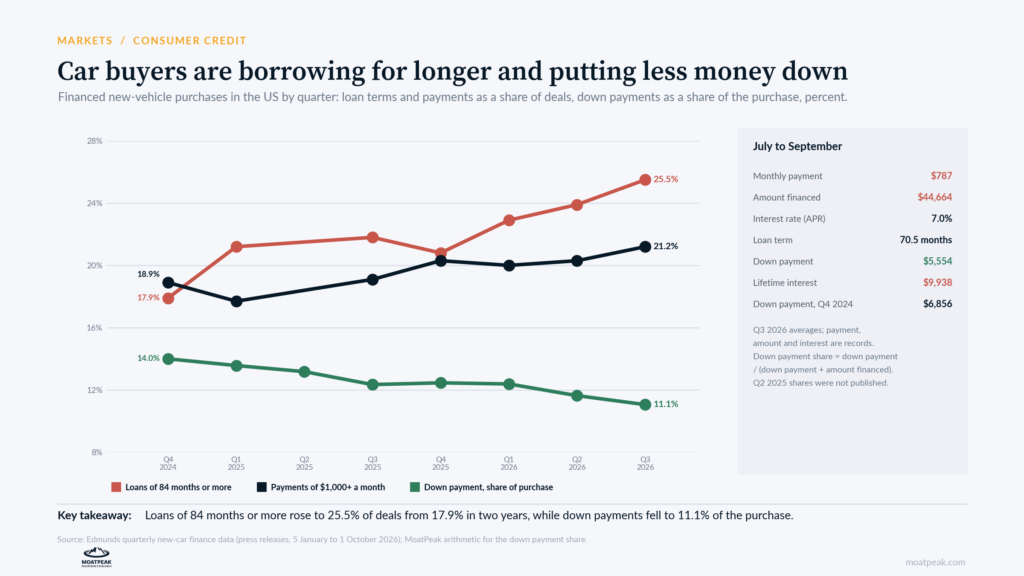
The average monthly payment on a new car reached a record $787 in July to September, according to Edmunds. More than one in five buyers who financed agreed to pay $1,000 or more a month, and one in four took a loan of seven years or longer. Edmunds called it “a remarkable display of consumer resilience.”
The details point somewhere else. Buyers are putting less money down and borrowing for longer, and lenders are approving more of them.
Less down, longer loans
The average down payment on a financed new car fell to $5,554 in the third quarter, from $6,856 at the end of 2024. Over the same period, prices kept rising. The average price paid for a new vehicle reached a record $51,109 in October, according to Kelley Blue Book. By our arithmetic, the down payment covered 11.1 percent of the purchase, down from 14.0 percent two years earlier.
Buyers borrowed a record $44,664 on average. Loans of 84 months or longer made up 25.5 percent of financed purchases, up from 17.9 percent at the end of 2024. The average interest rate stayed at 7.0 percent, the same as a year earlier. The payment rose because buyers borrowed more and for longer.
What the longer loan costs
We ran the numbers on the average third-quarter loan of $44,664 at 7.0 percent. Over 60 months, the payment is $884 and the interest totals $8,400. Over 84 months, the payment drops to $674, but the interest rises to $11,960.
The longer loan also builds equity more slowly. After three years of payments, the 60-month borrower still owes 44 percent of the original loan. The 84-month borrower still owes 63 percent, while the car keeps losing value.
Lenders are making it work
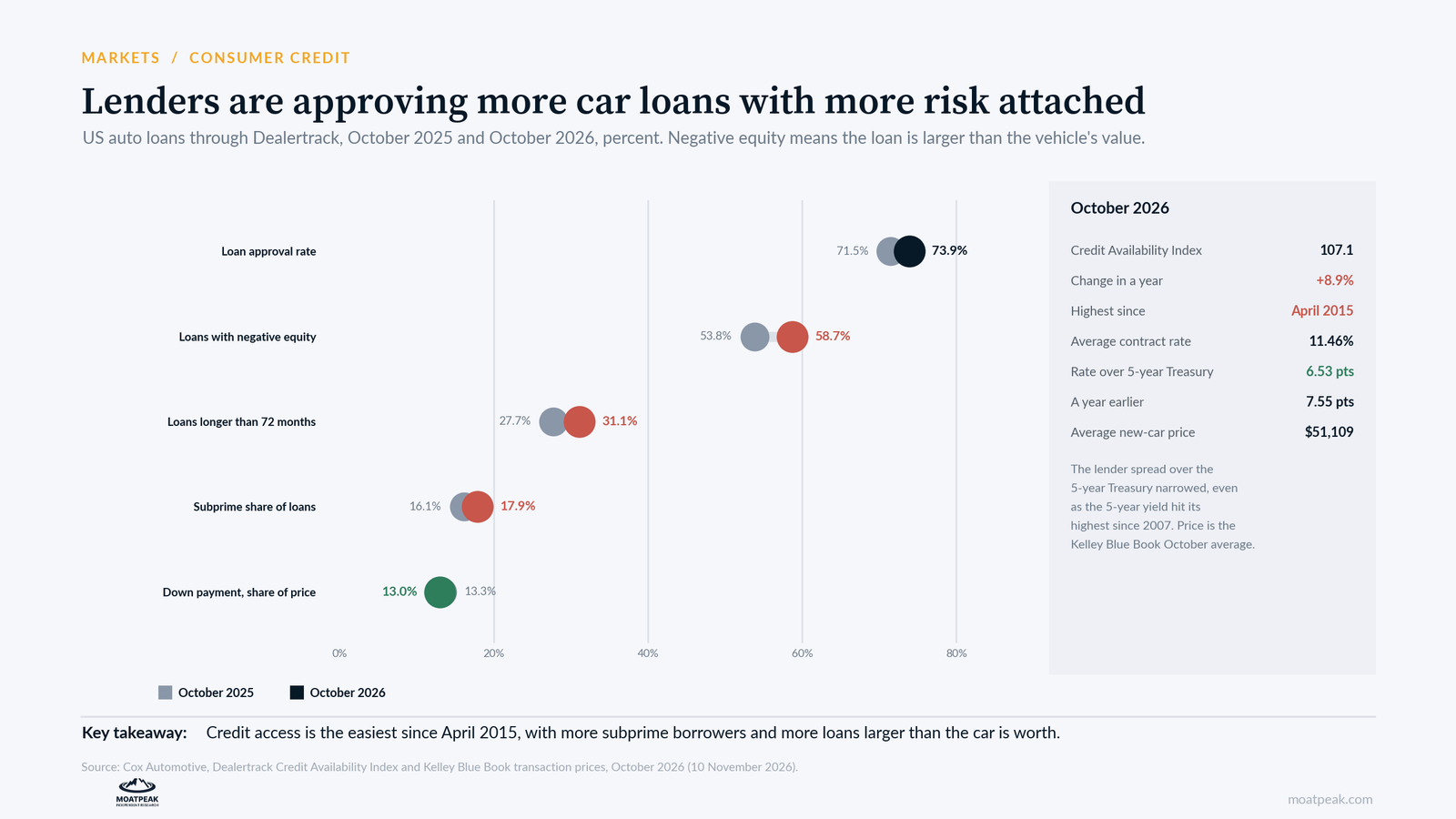
Data from Cox Automotive’s Dealertrack shows lenders loosening their standards. Its index of auto credit availability rose for a sixth straight month in October, to its highest level since April 2015. The approval rate climbed to 73.9 percent from 71.5 percent a year earlier. Subprime borrowers made up 17.9 percent of loans, up from 16.1 percent.
Lenders are also approving more loans that are larger than the car’s value. The share of loans with negative equity rose to 58.7 percent from 53.8 percent, higher than in any month from 2015 to 2019. Loans longer than 72 months made up 31.1 percent.
Lenders have absorbed part of the rise in interest rates. The average contract rate was 11.46 percent in October, 6.53 points above the 5-year Treasury yield. A year earlier, the gap was 7.55 points. The 5-year yield itself averaged 4.93 percent in October, its highest since 2007.
Our read
We read the record payments as a sign of looser credit more than of stronger buyers. Demand is holding up because lenders approve more loans, accept more negative equity and charge less over Treasury yields. That works while defaults stay low and used-car prices hold.
It also makes car sales more sensitive to credit than they look. If lenders tighten, many buyers could be shut out quickly, because so many deals depend on long terms and loans larger than the car is worth.
The case against us
Part of the record comes from what people buy. Cox notes that larger SUVs and full-size pickups lift the average price, while sales of vehicles priced from about $28,000 to $38,000 rose 9.6 percent from a year earlier. Many buyers with four-figure payments can afford them.
The lender data also has quirks. Cox says October’s rise in the approval rate largely reflected the exit of one near-prime lender with low approvals. And in October, down payments rose slightly to 13.0 percent of the price, while the share of loans longer than 72 months fell from September’s record.
What it means for your money
- Price a car loan by its total cost. On the average loan, an 84-month term costs about $3,560 more in interest than a 60-month term.
- Avoid rolling old debt into a new loan. With most loans already larger than the car’s value, negative equity can follow a buyer from one car to the next.
- Watch the lenders. Lenders growing subprime volume now carry the risk if defaults rise. Their loss provisions will show it first.
What we are watching
- Dealertrack credit availability for November, around 10 December: whether the subprime share and negative equity keep rising.
- Edmunds fourth-quarter finance data in early January: whether payments and loan terms set new records.
- Contract rates: Cox notes they may be starting to catch up with Treasury yields, which would push payments higher.
Educational research only. Not personalized investment advice. MB “MoatPeak Group”.
Get the Weekly Explainer
The biggest market story explained, every week. Free, by email.
Explore the research library
Company, industry and market reports with sources, charts, possible outcomes and the full evidence.
More free explainers
Markets, companies, portfolio basics and investing foundations. All free articles.
Back to Learn