

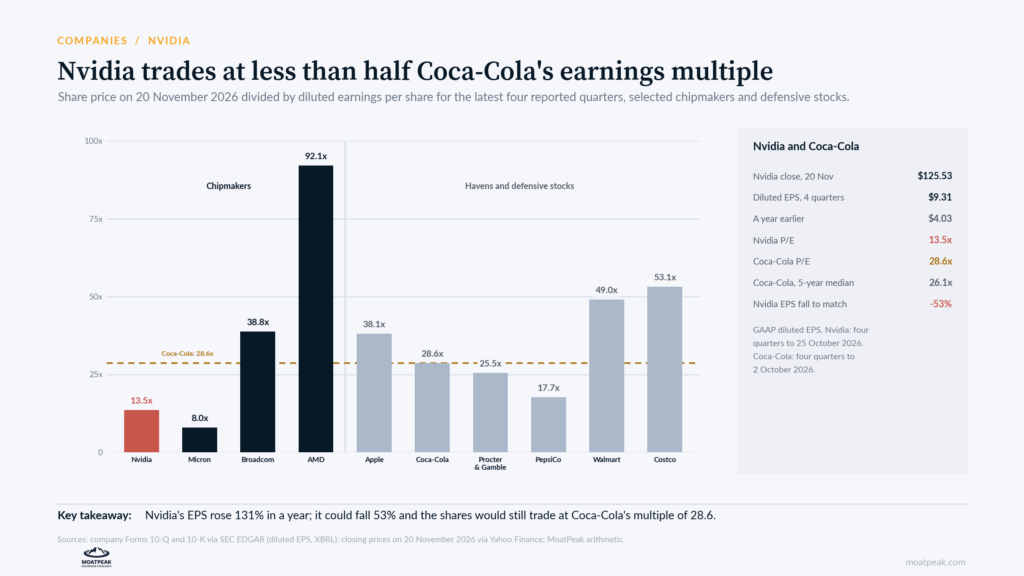
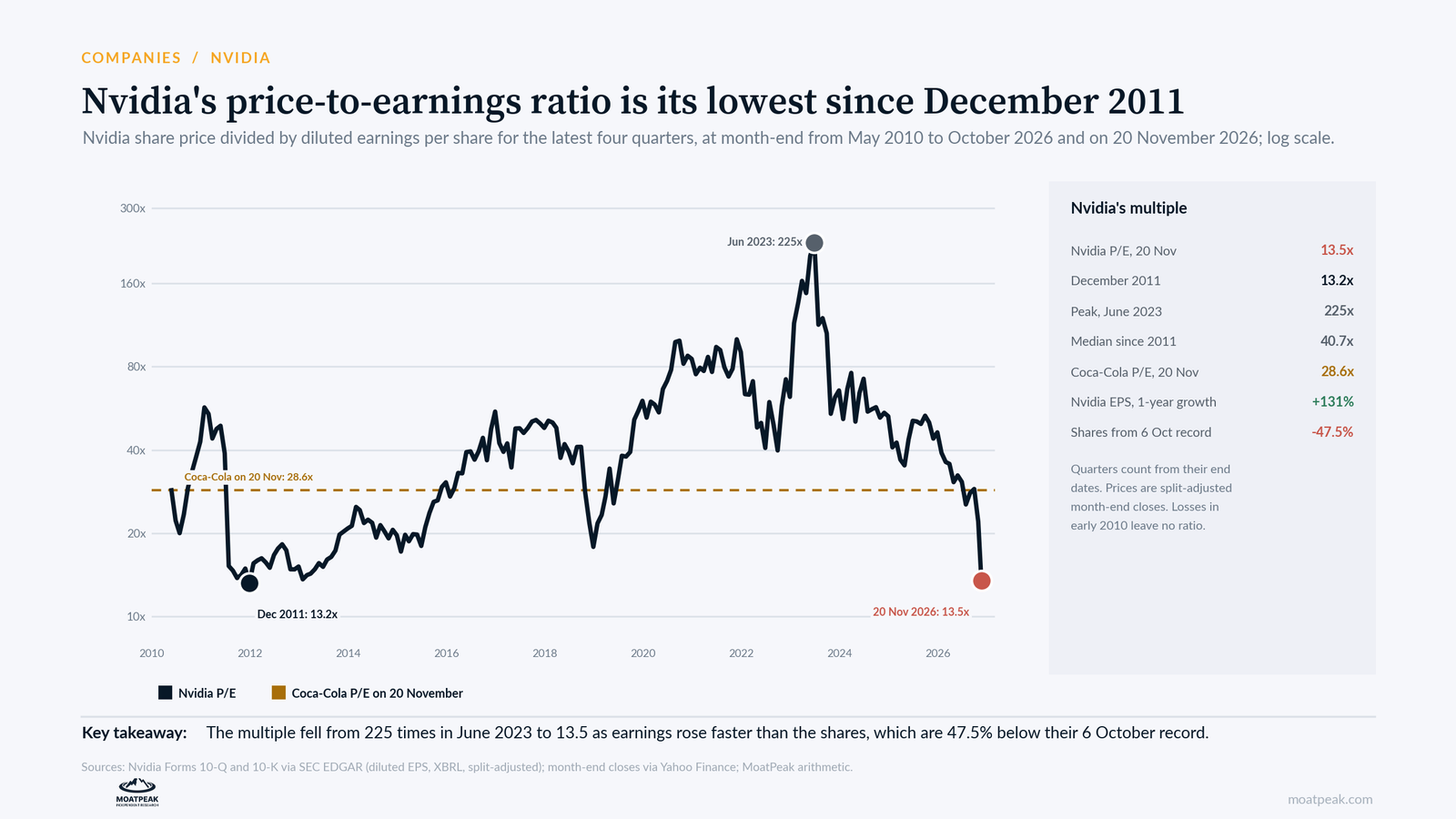
Nvidia’s shares closed at $125.53 on 20 November, down 14.0 percent that day and 47.5 percent below their record close of $239.24 on 6 October. Over its past four quarters, the company earned $9.31 a share, 131 percent more than in the four quarters a year earlier. At that price, the shares trade at 13.5 times earnings.
Coca-Cola closed at $96.99 the same day, up 38.7 percent in 2026. It trades at 28.6 times its earnings of the past four quarters, which rose 13 percent from a year earlier.
What the havens cost
The stocks investors buy for safety are priced very differently. Coca-Cola trades above its five-year median multiple of 26.1. Procter & Gamble trades at 25.5 times earnings, Walmart at 49.0 and Costco at 53.1. Apple trades at 38.1.
Among chipmakers, Micron is the cheapest at 8.0 times. Broadcom trades at 38.8 and AMD at 92.1.
Coca-Cola’s business is doing well. Third-quarter revenue rose 7 percent to $13.4 billion and comparable earnings per share rose 11 percent to $0.91. For 2026, the company expects comparable EPS growth of at least 11 percent. At 28.6 times earnings, investors are paying a premium for that stability.
Cheaper than at any month-end since 2011
Nvidia’s multiple was last this low at the end of December 2011, at 13.2. It peaked at 225 in June 2023, when the AI boom lifted the shares long before the profits arrived. Since then, earnings have grown much faster than the share price.
What 13.5 times implies
At $125.53, the stock would trade at Coca-Cola’s multiple if Nvidia’s earnings per share fell 53 percent to $4.39. Even then, Nvidia would be earning more than the $4.03 a share it made in the four quarters to October 2025.
Our read
The market is treating Nvidia’s profits as a peak and Coca-Cola’s as a floor. Nvidia’s earnings could halve, and its multiple would still be no higher than Coca-Cola’s. The havens, meanwhile, are priced as if little can go wrong: Walmart and Costco trade at about 50 times earnings, and Coca-Cola above its five-year median.
None of this makes Nvidia safe. The point is relative risk: after a 47.5 percent fall, a lot of bad news is already in Nvidia’s price, while the havens price in very little.
The case against us
A low multiple can be a warning. Chip profits swing: Nvidia’s earnings per share fell by more than half in its fiscal year to January 2023. Micron, at 8.0 times, shows how little investors will pay for earnings they see as cyclical.
A growing part of Nvidia’s sales also runs through its own balance sheet. Its latest quarterly report shows $390 billion of supply and capacity commitments, up from $50.3 billion a year earlier. Customers now take 64 days to pay. Nvidia has also guaranteed up to $118 billion of its partners’ obligations. If its customers struggle to raise money, earnings could fall faster than the multiple implies.
What it means for your money
- Price the havens too. A defensive stock at 50 times earnings can fall a long way if growth slows.
- Treat low multiples on cyclical profits with care. Nvidia’s earnings per share fell by more than half in fiscal 2023.
- Compare what each price assumes. At 13.5 times, Nvidia is priced for a sharp fall in profits; at 28.6, Coca-Cola is priced for steady growth.
What we are watching
- Nvidia’s fourth-quarter results, due in February: the company expects revenue of about $130 billion in a 14-week quarter.
- Nvidia’s next quarterly report: whether customers take even longer to pay.
- Coca-Cola’s 2027 outlook, due in February: whether its growth can support 28.6 times earnings.
Educational research only. Not personalized investment advice. MB “MoatPeak Group”.
Get the Weekly Explainer
The biggest market story explained, every week. Free, by email.
Explore the research library
Company, industry and market reports with sources, charts, possible outcomes and the full evidence.
More free explainers
Markets, companies, portfolio basics and investing foundations. All free articles.
Back to Learn