

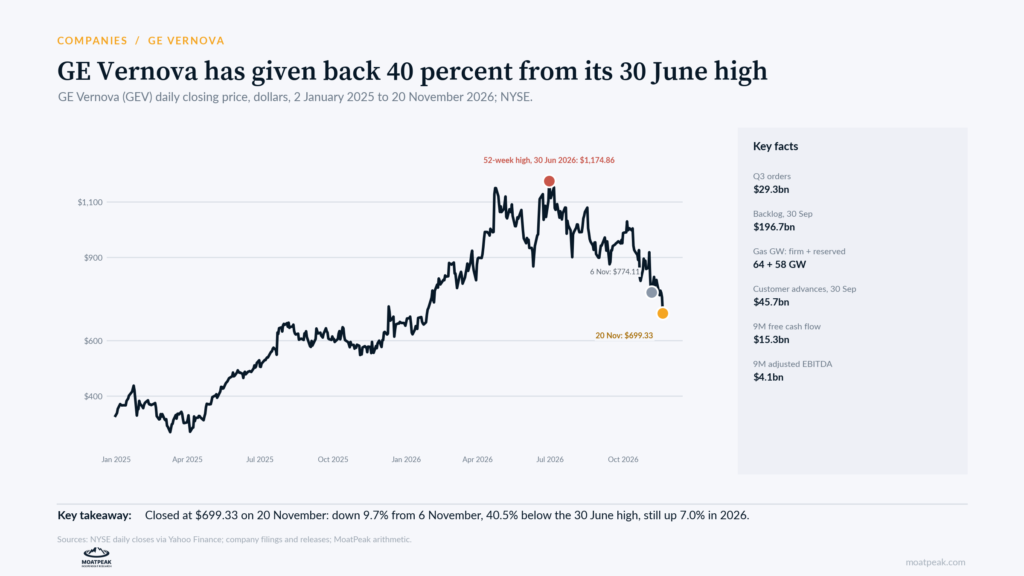
GE Vernova, which makes gas turbines, grid equipment and wind turbines and then services them for decades, closed at $699.33 on 20 November. That is 9.7 percent below its 6 November close and 40.5 percent below its 30 June high of $1,174.86, though still up 7.0 percent for 2026. The shares have had a hard month: they fell about 16 percent over 4 and 5 November, recovered part of that, then dropped 7.5 percent on 20 November alone.
Its 28 October results looked strong: $29.3 billion of orders, a $196.7 billion backlog, higher 2026 guidance and $5.4 billion of quarterly free cash flow. That last number deserves a closer look.
What the company sells
In the third quarter, Power, mainly gas turbines and their servicing, had revenue of $6.1 billion and a segment EBITDA margin of 21.4 percent. EBITDA is earnings before interest, taxes, depreciation and amortization, a rough gauge of operating profit. Electrification, the grid business, posted a 19.1 percent margin on $3.9 billion. Wind made 2.6 percent on $2.7 billion and lost $585 million at the EBITDA line over nine months. Management said about 80 percent of its roughly 100 gas turbine customers are traditional buyers and about 20 percent are buying for data centers.
What the price is betting on
At $699.33, with 264.7 million shares outstanding on 30 September, the market values GE Vernova at about $185 billion. That assumes the order boom lifts margins for years.
Pricing supports that. The company says third-quarter gas equipment orders were priced more than 20 percent above fourth-quarter 2025 levels, helped by more aeroderivatives, smaller turbines derived from jet engines. It expects 2026 gas orders to be priced about 50 percent above 2025 levels, and better-priced units only began shipping in the third quarter.
GE Vernova counts 122 gigawatts of gas equipment under contract: 64 gigawatts of firm orders and 58 gigawatts of slot reservations, where customers pay to hold a production slot before placing a firm order. It expects at least 130 gigawatts by the end of 2026.
What we think the market is missing
The record cash flow is mostly customers paying ahead. In the first nine months of 2026, GE Vernova reported $15.3 billion of free cash flow on $4.1 billion of adjusted EBITDA. Operating cash flow was $16.7 billion, including a $17.0 billion inflow from working capital, led by $19.5 billion of down payments on orders and slot reservations. Contract liabilities, the accounting name for cash received before delivery, rose from $25.8 billion at the end of 2025 to $45.7 billion on 30 September, partly through the Prolec deal.
That cash is real, but it is an advance on equipment still to be built, shipped and serviced, and much of it will be spent doing that. The pile grows only while orders and reservations outpace deliveries.
Meanwhile, GE Vernova is deploying the cash: $9.9 billion of buybacks since December 2024 (at an average of about $635 a share), $5.2 billion for Prolec and about $9.0 billion agreed for Trench Group, a high-voltage equipment maker, which it plans to fund half with cash.
Reported profit flatters too. Nine-month diluted earnings of $24.81 a share include a one-off pre-tax gain of $3.99 billion from revaluing the half of Prolec GE, a transformer maker, that GE Vernova owned before buying the rest in February.
In our view, margins are the right yardstick. Cash flow mostly shows how fast customers are paying ahead.
What would prove us wrong
- The float keeps growing. If orders outrun shipments for years, as sales of slots for 2032 delivery hint, the advances work like an insurer’s float, a lasting source of funding.
- Margins rise faster. If better-priced orders push Power margins well above the 19 to 21 percent guided for 2026, the profit engine could justify more of the price.
- Customers hold firm. Management said no customers had asked to exit slot reservations and cash terms were unchanged. If that holds as deliveries rise, the float is stickier than we assume.
What to watch
- 3 December: the chief executive speaks at an investor conference.
- 27 January 2027: fourth-quarter results. We will look at gigawatts under contract against the 130 target, orders against shipments, the change in contract liabilities and 2027 guidance.
- Late 2027: the expected Trench closing, subject to regulatory approvals.
For members: our verdict, the price test and what would change our mind are in the full report.
Educational research only. Not personalized investment advice. MB “MoatPeak Group”.
Get the Weekly Explainer
The biggest market story explained, every week. Free, by email.
Explore the research library
Company, industry and market reports with sources, charts, possible outcomes and the full evidence.
More free explainers
Markets, companies, portfolio basics and investing foundations. All free articles.
Back to Learn