

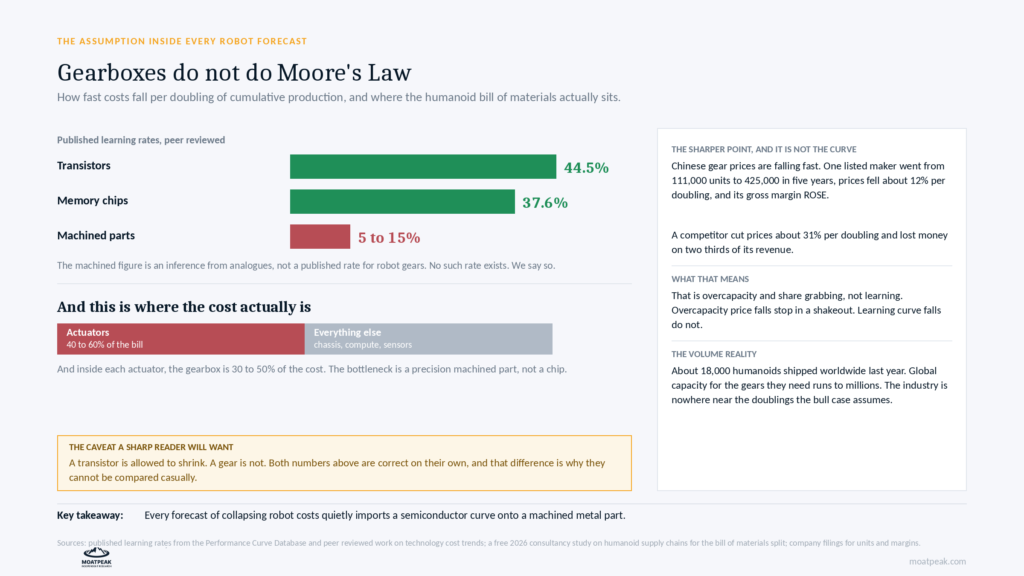
When people predict that the costs of humanoid robots will drop rapidly, they are usually going by the cost trends observed in semiconductors and applying them to mechanical components.
Actuators account for 40 to 60% of the total material costs and, for each actuator, the gearbox makes up 30 to 50% of that cost. The greatest difficulty lies in the precision machining rather than in the silicon components.
The figures published show that transistor costs decrease by 44.5% with each doubling of output and that those for memory fall by 37.6%; however, no published figures are available for harmonic drives or roller screws. Similar products generally show reductions of 5 to 15%, and the original 1936 paper on the learning curve stated that decreases in material costs were 5%, not 80%.
The change in this regard is that Chinese gear prices are dropping rapidly. One company listed had its output rise from 111,000 units to 425,000 over a five-year period, the price decreasing by approximately 12% with each doubling and at the same time its gross margin increased; another competitor, on the other hand, reduced its prices by about 31% with each doubling and ended up making a loss on two thirds of its revenue.
The fact that price reductions are the result of overcapacity with companies attempting to gain market share rather than genuine learning should be noted; price declines caused by overcapacity cease when the market has settled, whereas those caused by learning curves continue.
It is important to note that while transistors can be made smaller, gears cannot. As a result, the cost trends for the two cannot really be compared, and this difference is crucial.
Get the Weekly Explainer
The biggest market story explained, every week. Free, by email.
Explore the research library
Company, industry and market reports with sources, charts, possible outcomes and the full evidence.
More free explainers
Markets, companies, portfolio basics and investing foundations. All free articles.
Back to Learn