

There’s a good point being discussed right now, and we think it deserves attention. The main idea is right, and it’s something many people overlook.
Here’s the point: funds haven’t been selling artificial intelligence. Instead, they’ve been hedging. Short positions have jumped, but long positions haven’t changed much. So, the exposure remains, just covered by a layer of insurance.
This difference is important, but it’s often missed. Selling and hedging both show up as “reduced exposure” in headlines, but they mean very different things. Selling shows a change in belief, while hedging shows a change in confidence.
The idea that follows is this: when the market settles, the insurance comes off first, and then the upside can pick up just as quickly as the earlier drop.
That sounds reasonable. But as it’s written, it can’t really be proven wrong. There’s no number, threshold, or date. If the market goes up, it means the hedges came off. If not, then they’re still on.
A forecast needs a clear threshold and a date. Without those, it’s just a feeling.
So, here’s the same claim, but now it’s testable. I’ll use five measures that are published for free on set dates.
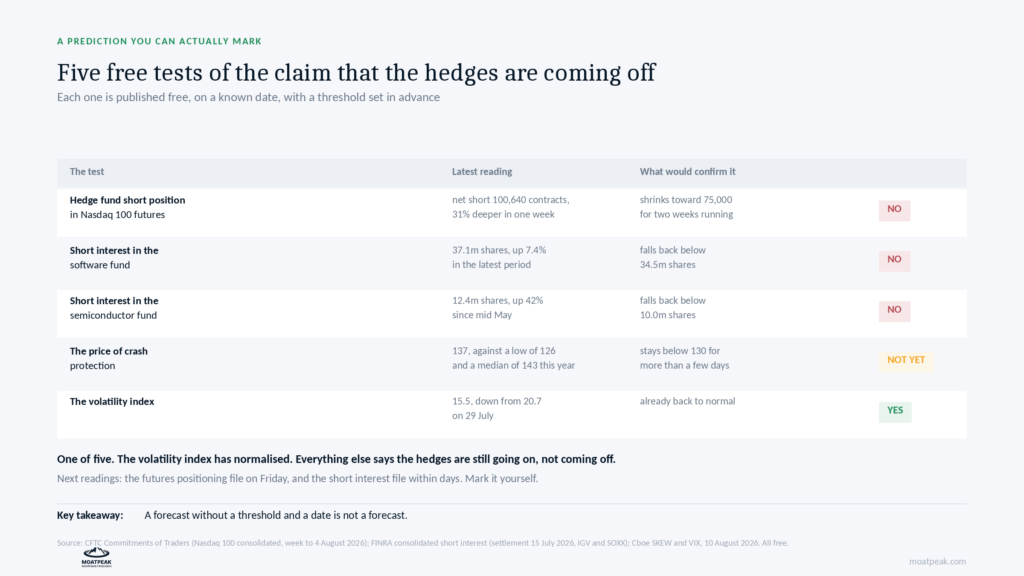
1. Hedge fund short positions in Nasdaq 100 futures. The regulator shares this every Friday afternoon, covering the previous Tuesday. The latest figure is a net short of 100,640 contracts, up 31% in one week. To confirm hedges are coming off, look for the net short to drop toward 75,000 for two weeks in a row.
2. Short interest in the software fund. This is published twice a month. The latest number is 37.1 million shares, up 7.4%, and it has the highest days to cover among its peers. Confirmation would be a drop below 34.5 million.
3. Short interest in the semiconductor fund. The latest figure is 12.4 million shares, up 42% since mid-May. Confirmation would be a drop below 10 million.
4. The price of crash protection. There’s a free index that tracks what investors pay to guard against a big drop. It’s currently at 137, with a low of 126 and a median of 143 this year. Confirmation would be if it stays below 130.
5. The volatility index is at15.5, down from 20.7 on July 29. This measure is already back to normal.
So far, only one out of five measures has returned to normal.
Volatility is back to normal. For the other four measures, though, insurance is still being bought, not sold. In the week ending August 4, leveraged funds added 16,430 short contracts and reduced 7,250 long ones. That means more hedging is happening.
This doesn’t mean the argument is wrong. It just hasn’t happened yet. Now you know exactly what to look for when it does. That’s more useful than just agreeing or disagreeing.
Here’s why we approach it this way. Anyone can share a convincing story about positioning. What’s harder (and what you should expect from anyone who wants your attention) is a claim that’s specific enough to be measured later. If it can’t be checked, it’s just entertainment.
Looking ahead, the futures positioning file comes out on Friday, and the short interest file will be released in a few days. Both are free and follow a set schedule, so you can track this scorecard on your own.
That’s the main idea.
Our full positioning work is at https://moatpeak.com.
Educational research only. Not personalized investment advice. MB “MoatPeak Group”.
Get the Weekly Explainer
The biggest market story explained, every week. Free, by email.
Explore the research library
Company, industry and market reports with sources, charts, possible outcomes and the full evidence.
More free explainers
Markets, companies, portfolio basics and investing foundations. All free articles.
Back to Learn