

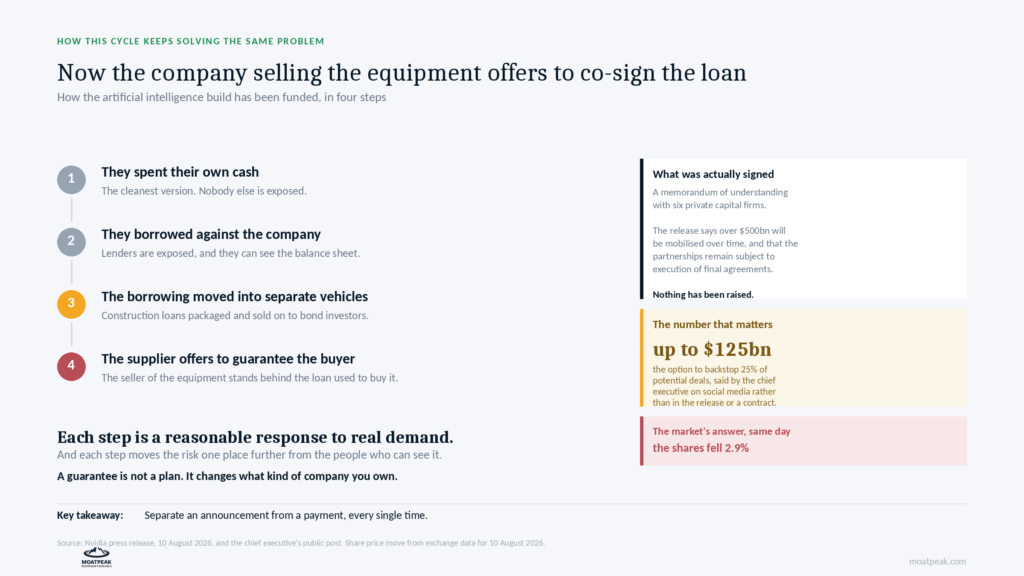
Yesterday, Nvidia said it had reached agreements with six major private capital firms (Apollo, BlackRock, Blackstone, Brookfield, Goldman Sachs, and KKR) to try to raise more than $500 billion for artificial intelligence infrastructure. The CEO also posted on social media that Nvidia could backstop up to $125 billion, or a quarter of the potential deals.
Before we get into the main argument, there are two important points to keep in mind.
These are just memorandums of understanding, which means the parties have agreed to try to reach a final deal. Nvidia’s press release even says the partnerships “remain subject to execution of the final agreements”.
Also, the $500 billion is just a goal for what the partners hope to raise over time. The money hasn’t been collected yet: there isn’t an account with $500 billion sitting in it. If someone talks about that figure as if it’s already real money, they’re not being accurate. In this market, it’s crucial to remember the difference between an announcement and actual payment.
It’s also important to note that the $125 billion backstop figure came from a social media post, not from the official press release or a term sheet. Saying you’re willing to guarantee something is more than just a plan, but it’s still not the same as a signed contract.
Now the part that matters anyway. A guarantee is not a plan. It is a promise to pay if somebody else does not.
Up to now, Nvidia’s business model was straightforward. It made a highly sought-after product, sold it, and got paid. Any issues after the sale were the customer’s responsibility.
If Nvidia stands behind the loans its customers use to buy its chips, its revenue becomes tied to whether those customers can service their debt. That is a fundamentally different business, and a considerably harder one. It is partly a lender now, and lenders are valued differently from manufacturers, for good reasons.
Here’s the main point I want you to remember, and it isn’t just about Nvidia.
Pay attention to the steps this cycle has taken.
First, companies used their own cash. This was straightforward, and no one else was at risk.
Next, they borrowed money using their balance sheets. Lenders took on some risk, but they could review the companies’ financial statements.
After that, borrowing shifted to separate entities, and construction loans were bundled and sold to bond investors who never see the actual projects.
Now, the supplier is offering to guarantee the buyer’s obligations.
Each of these steps is a reasonable response to real demand. None of them is fraudulent or even especially unusual. But with each step, the risk moves further away from those who can actually see it.
This pattern doesn’t mean the technology will fail. We don’t think it will. It’s just a sign of where we are in the cycle, since financing structures usually get more complex later on. When the focus shifts from the product itself to how it’s being paid for, that tells you something important.
So, the response to the $500 billion financing announcement was negative. This shows that concerns about circularity aren’t just found in research reports.
On the other hand, there’s a strong argument worth mentioning: this financing really does boost demand for chips, energy, and data centers, and it brings in huge amounts of long-term capital that weren’t involved before. If the projects succeed, this is exactly how big infrastructure projects have always been funded, and the guarantee is never needed. That’s the main scenario, and it could very well be correct.
The real question is what you’re being paid to take on that risk, and whether you even realized you were taking it.
Our full read on the financing chain is at https://moatpeak.com.
Educational research only. Not personalized investment advice. MB “MoatPeak Group”.
Get the Weekly Explainer
The biggest market story explained, every week. Free, by email.
Explore the research library
Company, industry and market reports with sources, charts, possible outcomes and the full evidence.
More free explainers
Markets, companies, portfolio basics and investing foundations. All free articles.
Back to Learn