

Most people overlook these decisions, but they reveal a lot about how these companies view artificial intelligence.
Let’s start with how it works. It’s actually simple once you see it explained.
When a company buys something expensive that will last, it doesn’t count the full cost in the year it’s bought. Instead, it spreads the cost over the years it expects to use it. This yearly portion is called depreciation, and it lowers reported profit.
So, the guess about how long a computer will be useful directly affects reported profit. If you assume it lasts longer, each year’s cost is smaller and profit rises. If you assume a shorter life, profit drops. Nothing physical changes: same machines, same power, same staff. Only the estimate changes.
It’s just an estimate. The company discloses it in a note near the end of the report, auditors check it, and there’s no vote on it.
Now, let’s see what four companies actually did.
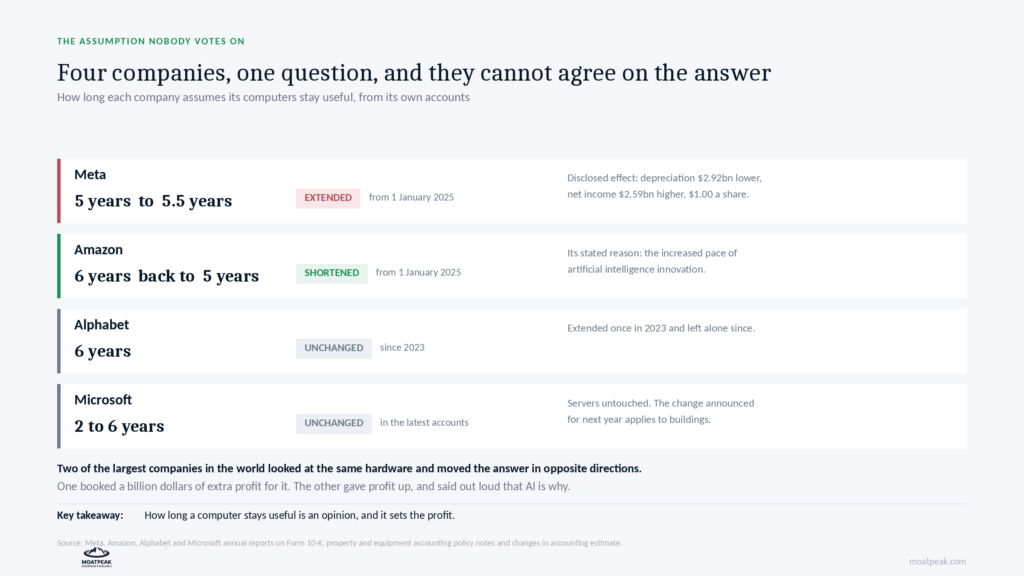
Meta decided to extend the expected life of most of its servers and network equipment from five years to five and a half, starting January 2025. As required, it reported the impact: depreciation dropped by $2.92 billion, net income rose by $2.59 billion, or about a dollar per share.
Amazon did the opposite. In the same month, it changed some servers and networking equipment from a six-year life back to five years. This lowers profit instead of raising it. Amazon said it made the change because AI is advancing faster.
Think about that. Amazon had just extended server life from five to six years in 2024, but reversed the decision within a year, citing AI as the reason.
Alphabet has kept its server life at six years since 2023 and hasn’t changed it.
Microsoft still uses a two to six year range for its servers and hasn’t changed it. However, it’s increasing the expected life of its buildings from fifteen to twenty-five years, starting this financial year. To be clear, this change is only for the building structure, not the computers inside. Microsoft’s previous fifteen-year estimate was the shortest among its peers. Meta assumes buildings last twenty-five to thirty years, Alphabet up to twenty-five, and Oracle up to forty. So, Microsoft is just catching up, not pushing the limits.
So, what does this disagreement mean?
Two of the world’s most advanced companies bought almost the same equipment in the same year, but came to opposite conclusions about how long it would last. One added $2.59 billion in profit with its choice. The other gave up profit and blamed AI; neither can be right. And the difference between them is not a rounding item; it is billions of dollars of reported earnings that flow straight into every valuation built on those earnings.
Here’s why this matters for the bigger picture.
Yesterday, we discussed the risk of investing money for a ten-year return when the advantage might only last three years. The depreciation estimate is the company’s answer to that question, written in its official filings.
If a company shortens the expected life of its hardware, it’s saying as clearly as possible that the equipment becomes outdated faster than it thought before. If it lengthens the life, it’s saying the opposite.
At the moment, the two biggest buyers of AI hardware are giving you completely different signals.
There’s a fair point to consider. Extending asset lives isn’t always a trick. Equipment really does last longer now, and older chips often get reused for less demanding tasks instead of being scrapped. Amazon has said its servers pay for themselves in just under three years, which, if accurate, would make most of this debate less important. Meta’s change was properly disclosed and audited. No one. Here’s a good habit: when reported profit goes up but cash doesn’t, check which assumption changed. It’s almost always disclosed, usually dull, but often the most honest part of the report, read in the document.
Look for the note called “Property and Equipment”. It’s usually about four pages from the end.
You can read our full analysis of which parts of this argument hold up at https://moatpeak.com.
Educational research only. Not personalized investment advice. MB “MoatPeak Group”.
Get the Weekly Explainer
The biggest market story explained, every week. Free, by email.
Explore the research library
Company, industry and market reports with sources, charts, possible outcomes and the full evidence.
More free explainers
Markets, companies, portfolio basics and investing foundations. All free articles.
Back to Learn