

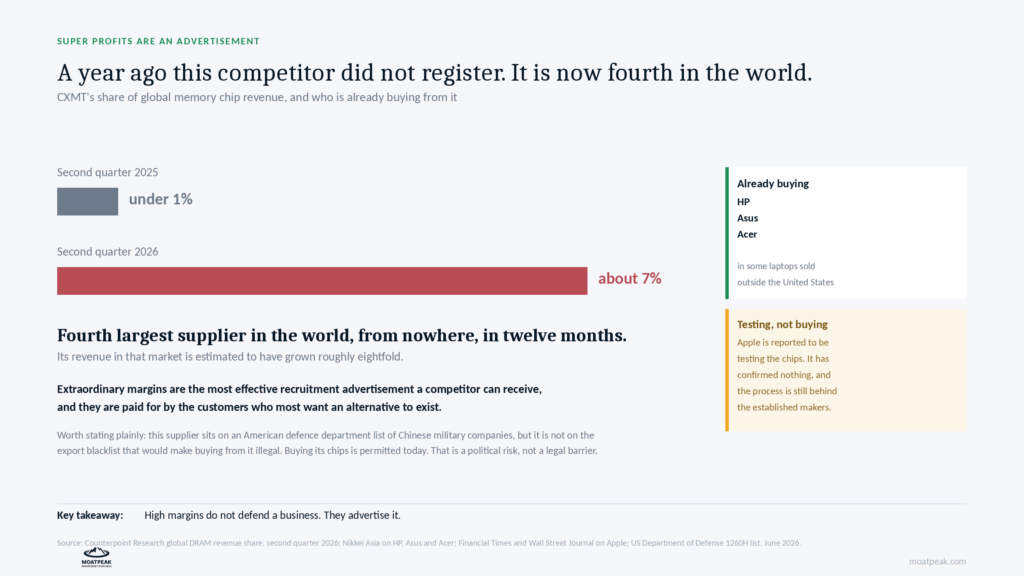
Let’s start with the facts. CXMT is a Chinese memory chip maker. A year ago, it had less than 1% of the global market. Now, it makes up about7% of memory chip revenue and is the fourth largest supplier worldwide. Its revenue in this market is estimated to have grown eight times over in just a year.
HP, Asus, and Acer already use CXMT’s chips in some laptops sold outside the US. There are also reports that Apple is testing them.
It’s important to be cautious here, since this story is being exaggerated on both sides.
Testing doesn’t mean buying, and Apple hasn’t confirmed anything. CXMT’s manufacturing process still lags behind established companies, and most of its capacity is already committed. Politically, it’s important to be precise: CXMT is on a US Defense Department list of Chinese military companies, but it’s not on the export blacklist, so buying from them isn’t illegal. Right now, purchasing its chips is allowed. This is a political risk, not a legal one, though many reports have confused the two.
What matters here isn’t the headline, but the underlying mechanism.
The memory shortage is real, and so are today’s profits. That’s why we’re invested in this sector. But high margins aren’t just a reward for scarcity.
They also serve as an advertisement.
A 60% margin is like a public signal to every capable competitor and every government policy maker, showing exactly where the profits are and how big they are. These margins are paid by customers, who have every reason to look for alternatives since they’re the ones footing the bill.
That’s the main point. High prices bring in new suppliers. This is not just a theory; it’s a process with clear steps: notice the margin, raise money, build capacity, qualify the product, and gain market share. In the memory chip market, this is happening now, and it has taken a competitor from zero to fourth place very quickly. So what should we do? Keep holding onto the shortage, since it is real. But hold a smaller position than current earnings might suggest. And don’t assume today’s high margins will last for years. That’s the mistake the current share price is encouraging.
Here’s the bigger lesson: When you see a business making unusually high profits, don’t just ask if those profits are real. Ask what those profits are signaling, who is paying attention, and how long it will take for others to respond.
Sometimes, it takes decades for others to respond because the barriers are physical, regulatory, or even geological. Other times, it only takes eighteen months. The difference between those two timelines is most of what you are paying for.
Today’s research is available at https://moatpeak.com
Educational research only. Not personalized investment advice. MB “MoatPeak Group”.
Get the Weekly Explainer
The biggest market story explained, every week. Free, by email.
Explore the research library
Company, industry and market reports with sources, charts, possible outcomes and the full evidence.
More free explainers
Markets, companies, portfolio basics and investing foundations. All free articles.
Back to Learn