

For about a decade, it held one of the strongest positions in software. Developers flocked there because everyone else did too.
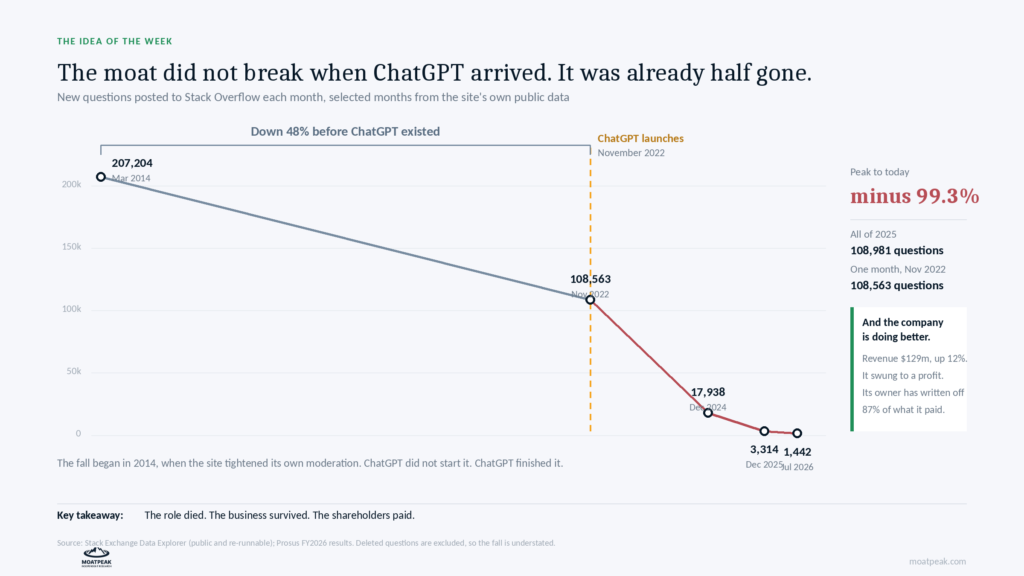
In March 2014, the site got 207,204 new questions in just one month.
Last month, it received only 1,442.
That is a fall of 99.3%, and you can check it yourself. Stack Exchange publishes its own data through a public query tool that anybody can re-run in a browser.
Here’s where most people get it wrong.
Many blame ChatGPT for the collapse. But when ChatGPT launched in November 2022, the site was already down 48% from its peak, which happenedeight years and eight months before. The decline actually started in 2014, when Stack Overflow made moderation stricter and began closing questions more quickly.
ChatGPT didn’t start the decline. It finished it.
Here’s another comparison that hits harder than a percentage: In all of 2025, the site had 108,981 questions. In just November 2022, it had 108,563. Now, a whole year matches what used to be a single month.
But there’s a twist: this is more of an investment story than a sad one.
The company itself is doing fine. Revenue is $129 million and growing by 12%, and it has just become profitable. It sells software to businesses and licenses its archive to AI companies. What changed was its role, not its business.
The owners, however, did not do as well. The parent company paid about $1.8 billion in 2021 and has since written off around 87% of that. In their own audited words, the business is not performing as expected “following the disruption caused by generative AI.”
So what question does this really answer?
It’s not “is AI overhyped?” The answer is more specific and more: a competitive advantage doesn’t last forever. In the past, it lasted a long time. Railways and electricity created huge value, even as individual companies disappeared and shareholders lost out. Building a railway took decades, so businesses had years to earn back their investment. Today, a software competitor can show up worldwide in a single afternoon.
Stack Overflow didn’t require much capital, so its shareholders lost a story, not a fortune.
Building AI is the most capital-intensive project companies have ever taken on.
This leads to a question I haven’t seen asked clearly: Is it safe to invest money that takes ten years to pay back, when the advantage might only last three?
If the answer is no, the investment can fail even if the technology works perfectly. Every technical promise can be fulfilled, but the money might not return because someone else’s version arrived before you finished paying off your investment.
So what should you do? Before investing in anything capital-intensive in tech, ask yourself two questions and compare the answers: How long will it take for this spending to pay for itself? How long will the advantage actually last?
If the first number is bigger than the second, no amount of demand growth will save you.
But it’s important to consider the other side, because this argument has a real weakness: AI could end up being more like electricity than a website. If that happens, the infrastructure keeps its value for many generations, and a ten-year payback makes sense. That’s the honest counterpoint, and it’s why we prefer assets that stay useful no matter who wins the software race. A turbine or a grid connection does. A chip built for one specific problem might not.
You can find our full analysis of which parts of the build we think will pass that test in today’s research.
Read it at https://moatpeak.com
Educational research only. Not personalized investment advice. MB “MoatPeak Group”.
Get the Weekly Explainer
The biggest market story explained, every week. Free, by email.
Explore the research library
Company, industry and market reports with sources, charts, possible outcomes and the full evidence.
More free explainers
Markets, companies, portfolio basics and investing foundations. All free articles.
Back to Learn