

Earlier this week, we jotted down a quick list of things that genuinely caught our eye: gold and gold miners, telecom companies with strong cash generation, solar, and pipelines.
That’s four industries: precious metals, communications, energy transition, and energy infrastructure. On paper, they seem to have almost nothing in common. If you’d asked us if this list was diversified, we’d have said, “Of course!”
But then we pulled up the chart, and it begged to differ, twice.
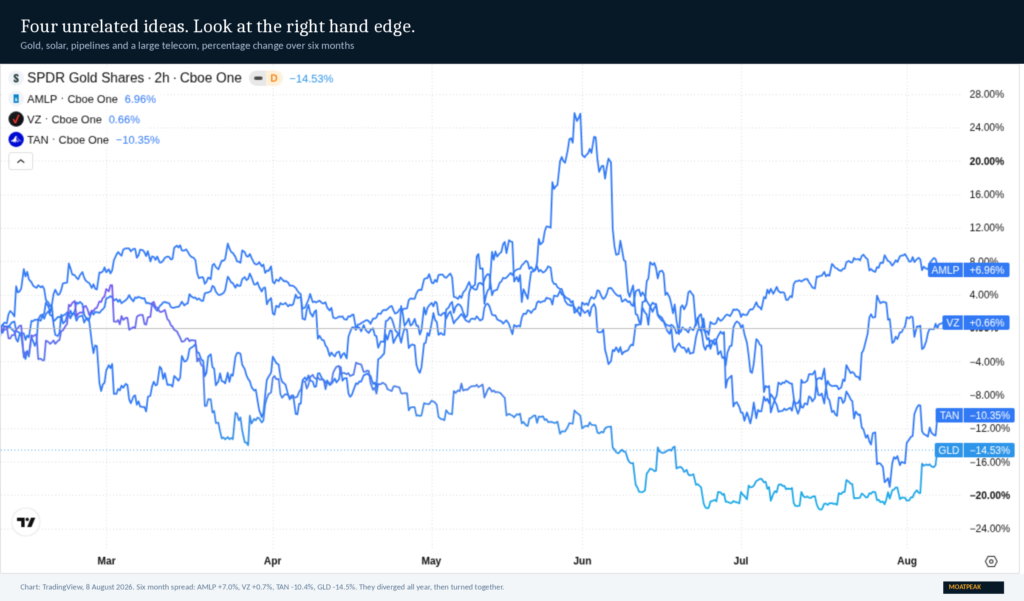
Here’s the first surprise: Over the past six months, these four didn’t move together at all. Pipelines climbed about 7 percent, telecom stayed about flat, solar dropped roughly 10 percent, and gold fell around 14 percent. That’s more than a 21-point spread between the best and worst performers.
So our instinct that these were just one big bet? The evidence says we were simply wrong. Whatever might connect them wasn’t showing up in the prices.
We could have quietly dropped the idea. Instead, we looked at the right edge of that chart, because what we found next was even more interesting.
In the final stretch, all four turned up together.
Assets that had gone their separate ways for six months suddenly started moving as one. And nothing happened in gold mines, fiber networks, solar farms, or pipelines that week to explain the shift. No shared customer, supplier, or technology.
What changed? Expectations about interest rates.
That’s the real takeaway, and it’s sharper than what we thought at first. These four aren’t always one big bet. They’re unrelated assets that just became one bet, with a brand new correlation.
Once you see why, it’s obvious. Gold tends to do well when real interest rates drop. Telecom cash flow is valued off a yield, so it re-rates when yields fall. Solar projects live or die by the cost of capital because of their long payback periods. And pipelines are often bought as bond substitutes for their steady payouts.
So, four different industries, but one shared sensitivity. It was dormant for six months, then suddenly switched on.
This isn’t just a portfolio note. It really matters for risk. When correlations are low, owning four things genuinely spreads out risk. When they all start moving together, those same four positions become one big position, and it can happen overnight, without any trading. Your risk just grew while you weren’t looking.
And here’s the uncomfortable part. We have to mention it, even though it goes against our own list. Elsewhere this week, we wrote that long-term interest rates are still rising, even though economic data is weak. This suggests the real issue is a shortage of long-term capital, not inflation. If that’s true, the shared sensitivity connecting these assets might be leading in the wrong direction. The factor that just brought them together could also pull them apart just as quickly.
We’d rather write that down now than have to explain it later.
So what does this mean for you? Check your holdings for shared sensitivities, not just shared industry. The question isn’t what these companies do. It’s what one thing has to be true for all of them to work. If the answer is a single thing, then you really own one position, no matter how many tickers you see on your statement.
How we’re sizing this position, and the specific level that would tell us the rate view has turned, are in this week’s research.
You can read it at https://moatpeak.com.
Educational research only. Not personalized investment advice. MB “MoatPeak Group”.
Get the Weekly Explainer
The biggest market story explained, every week. Free, by email.
Explore the research library
Company, industry and market reports with sources, charts, possible outcomes and the full evidence.
More free explainers
Markets, companies, portfolio basics and investing foundations. All free articles.
Back to Learn