

That is the highest number Goldman has ever recorded.
A call option is a bet that prices will rise. People do not usually buy that many if they think something is cheap. They do it when they are worried about missing out.
At the same time, the cost investors paid for downside protection had its biggest two-day drop in almost ten years. People were not just betting on gains. They were selling their insurance to fund those bets.
In just a week, the stock market went from panic to excitement.
Those are two different emotions, and only one of them is a reason to own anything.
Now let’s focus on an area most people ignore, which is the main point today.
In the bond market, the cost to insure the debt of the biggest artificial intelligence spenders is rising again.
This needs some explanation, since it sounds technical but isn’t. When you lend money to a company, you can buy insurance in case the company cannot pay you back. The price of this insurance is a real-time, tradeable view on whether the company can meet its payments. It does not reflect how exciting the shares are, but whether the money will actually come in.
That price is rising. Here’s what caught our attention: the same signal showed up around July 20, right before the technology selloff. It faded after the forced selling stopped. Now it has returned.
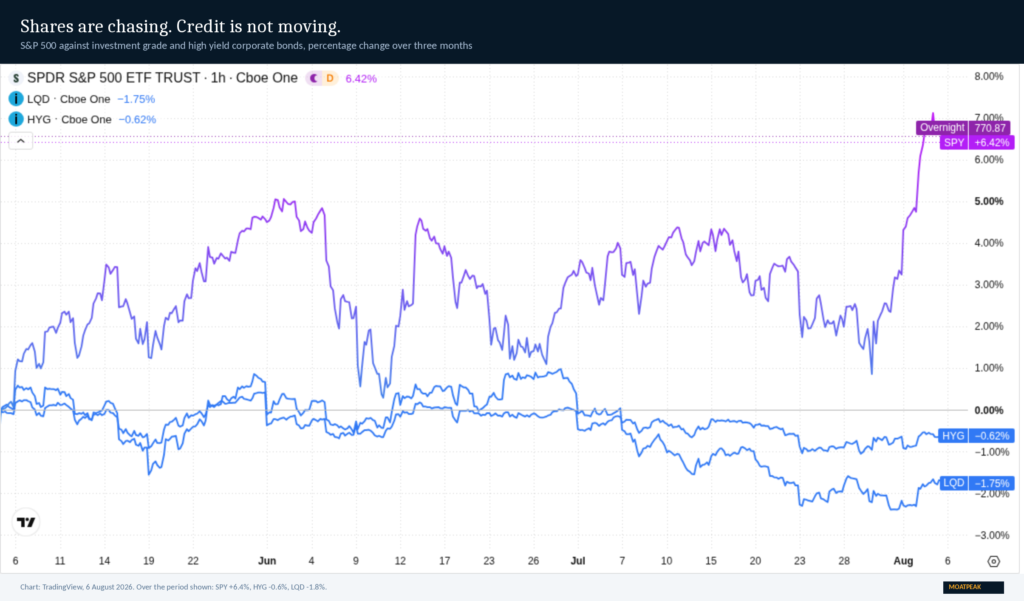
This gap is also growing, even though the volatility for those technology shares remains steady.
So, two groups of professionals are looking at the same companies but coming to opposite conclusions. Shareholders are chasing gains, while lenders are quietly raising their prices.
When these two groups disagree, we side with the lenders. It’s not because they are smarter, but because of their job. Shareholders buy into the future, and the future is uncertain, so it makes sense for them to be optimistic. Lenders only get back a fixed amount, so gains do not help them. That’s why lenders always focus on one thing: whether the money will actually be there.
That makes This means credit is not a good way to judge how exciting something is, but it is a better way to judge if it will work. be fair about the other side. Credit spreads widen for reasons other than danger, including simple supply, and the businesses underneath genuinely improved this week. This is a whisper, not a siren, and we are treating it as one notch of caution rather than a reversal.
What does this mean for you? If you want to know if a story is real, look to the person who gets paid back, not the one who gets paid up front. In a company, that’s the lender. In your own life, it’s usually the person who carries the risk if things go wrong. Their view may be less exciting, but it is often more accurate.
The exact spreads we are tracking, and the point where a quiet warning would become a bigger concern, are detailed in today’s Compass.
Read it at https://moatpeak.com
Educational research only. Not personalized investment advice. MB “MoatPeak Group”.
Get the Weekly Explainer
The biggest market story explained, every week. Free, by email.
Explore the research library
Company, industry and market reports with sources, charts, possible outcomes and the full evidence.
More free explainers
Markets, companies, portfolio basics and investing foundations. All free articles.
Back to Learn