

Most people are about to learn the wrong lesson from yesterday, and that mistake could be costly. Here’s the real takeaway.
At first glance, it looks like the market is turning against capital spending. Companies putting a lot into artificial intelligence seem to be getting punished, so some might think it’s best to avoid those making big investments.
But that idea doesn’t hold up, and here’s an example that proves it wrong.
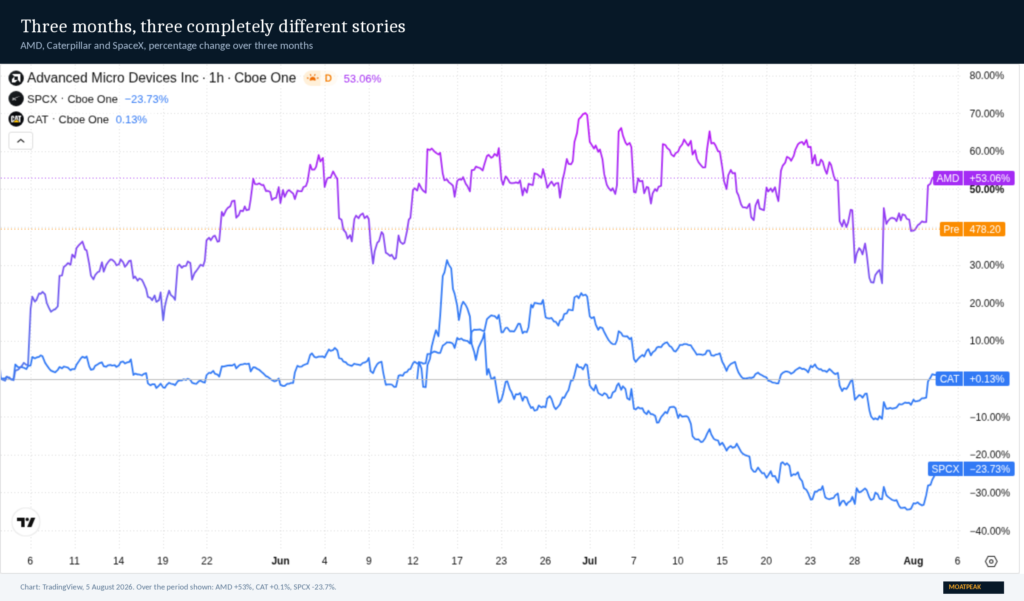
On the same day, AMD’s stock dropped after it spent $808 million instead of the expected $298 million. Meanwhile, SpaceX reported spending $18.369 billion in just one quarter.
SpaceX shares went up nearly 10 percent, marking their best day since June.
Eighteen billion dollars was rewarded. Eight hundred million was punished.
If the market truly disliked capital spending, this wouldn’t make sense.
The real difference isn’t the size of the spending. It’s how the number compares to what people expected. SpaceX’s huge spending was actually a bit less than the $18.58 billion the market expected. AMD’s smaller amount was almost three times higher than what was predicted.
The market isn’t punishing big budgets. It’s punishing surprises.
Here’s a simple example. If a builder quotes you fifty thousand and charges fifty thousand, that’s good. If another builder quotes five thousand but bills fifteen, that’s a problem, even though the second bill is smaller. The issue isn’t the amount, it’s the estimate.
Markets act the same way, and there’s a logical reason for it. When a budget is known, analysts can plan for it, adjust their models, and set prices accordingly. But when a budget comes as a surprise, it’s more than just a cost: it signals that the company’s forecasting isn’t reliable. That makes all their numbers less trustworthy, so the share price drops by more than just the extra spending.
It’s important to remember this difference. In the next few quarters, we’ll see many big capital spending numbers. If you treat all of them as bad news, you could miss out on good companies.
There’s another issue affecting SpaceX that shouldn’t be confused with spending. A lock-up is ending, which will release up to about 911.5 million shares. That’s a supply issue, not a spending issue, and they should be considered separately.
When a company announces a big investment, it makes sense to check whether this is actually planned? If the number was explained and expected, it’s just information. If it’s a surprise, it tells you something about the management, not just the money.
We explain how to separate these issues in practice, and which companies we’d still invest in, in today’s Compass.
You can read it at https://moatpeak.com.
Educational research only. Not personalized investment advice. MB “MoatPeak Group”.
Get the Weekly Explainer
The biggest market story explained, every week. Free, by email.
Explore the research library
Company, industry and market reports with sources, charts, possible outcomes and the full evidence.
More free explainers
Markets, companies, portfolio basics and investing foundations. All free articles.
Back to Learn