

Something shifted yesterday. Once you notice it, you’ll look at every earnings report differently for the rest of this cycle.
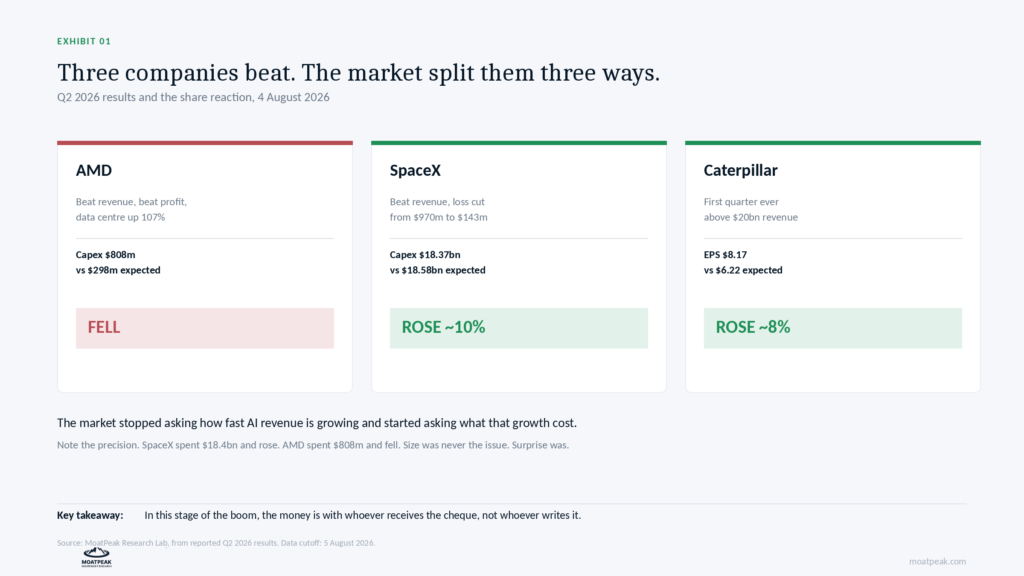
AMD released its results. Revenue was $11.54 billion, beating the $11.28 billion expected. Profit also beat forecasts. Its data center business grew 107 percent to $6.72 billion. The company gave a strong outlook for next quarter.
But the stock price dropped.
Caterpillar also reported that day. The company makes engines, diggers, and generators. Revenue jumped 24 percent to $20.54 billion, the first time it has ever topped $20 billion in a quarter. Net profit rose 65 percent. Earnings per share were $8.17, well above the $6.22 expected, marking its biggest beat in five years. Power equipment sales rose 17 percent, and construction equipment sales climbed 35 percent, mostly thanks to data center construction.
Its stock jumped nearly 8 percent.
A leading chip company in the AI boom grew its main business by 107 percent but saw its stock fall. Meanwhile, a century-old maker of yellow machines was rewarded by the market.
Here’s what happened, and it’s actually simple.
For the past two years, investors have asked every company involved in AI how quickly their AI revenue is growing. Yesterday, the question changed to: what did it cost to get that growth?
AMD did not answer this question well. Capital spending was $808 million, much higher than the $298 million expected, and free cash flow was about 20 percent below forecasts. The revenue growth was real, but so was the unexpected cost, which no one had factored in.
Caterpillar didn’t have to answer that question. It isn’t building the future itself. Instead, it sells equipment to those who are, and gets paid in cash when it delivers, before anyone knows if the project will succeed.
That’s the main point. Right now, the winners are the ones getting paid, not the ones spending.
It’s worth thinking about why this is happening now and not a year ago. Early in any expansion, spending looks like ambition. The market rewards it because spending shows confidence, and confidence hints at future revenue. Later, spending turns into a cost, since the market has already priced in that confidence and now wants to see results. This shift isn’t announced. It just shows up in the market’s reaction one day and then it sticks.
To be fair to AMD, growing a division by 107 percent is a huge achievement, and the company is not in trouble. The market’s reaction wasn’t about whether AMD is a good company. It was about who is capturing value right now, which is a different question with a different answer.
What it means for you. What does this mean for you? In any boom, look for businesses that benefit when others are optimistic. The classic example is selling shovels. More seriously, ask yourself if what you own is spending to create opportunities, or getting paid because someone else is. Go next, and the companies we would want on the receiving end are in today’s Compass.
You can read it at https://moatpeak.com.
Educational research only. Not personalized investment advice. MB “MoatPeak Group”.
Get the Weekly Explainer
The biggest market story explained, every week. Free, by email.
Explore the research library
Company, industry and market reports with sources, charts, possible outcomes and the full evidence.
More free explainers
Markets, companies, portfolio basics and investing foundations. All free articles.
Back to Learn