

There’s a lot of talk these days about whether artificial intelligence is in a bubble, but the real issue is that most people are focusing on the wrong question.
Most people start by looking at price. Are these stocks too expensive compared to what the companies actually make? That’s a smart approach, and it’s how bubbles have often been identified before.
If you use that test today, the results are surprising. The premium investors pay for the largest tech companies has almost disappeared. Software stocks are much cheaper compared to the rest of the market than they were during the dot-com era. By price alone, there’s no obvious bubble, so some people think the concern is overblown.
But there’s a bigger question: it’s not just about what you pay, but what you’re assuming to make that price seem fair.
At the moment, profit growth forecasts for the next ten years are even higher than what the market expected in 2000.
That fact changes the whole conversation.
Valuation isn’t only about price. It’s about price compared to expectations. Any price can look reasonable if you set high enough expectations. The numbers seem normal only because the forecasts have been pushed higher.
The bubble didn’t disappear. It just shifted.
It has moved somewhere less obvious, which is why it deserves attention. A high multiple is easy to spot because it appears in every chart, article, and comparison. Everyone notices and talks about it.
However, no one writes headlines about a high ten-year growth assumption, because most people don’t notice it. We believe this isn’t a technical detail, but a belief. But it’s actually the biggest belief in the whole setup.
Here’s another point: company profits are now further above their long-term trend than at any time since 1955. Second quarter growth is expected to be about 33 percent, and every sector is growing for the second quarter in a row. The forecast is bold, and the starting point is already impressive. These two facts are connected. The forecast is so optimistic partly because recent results have been so strong that it seems reasonable to expect more.
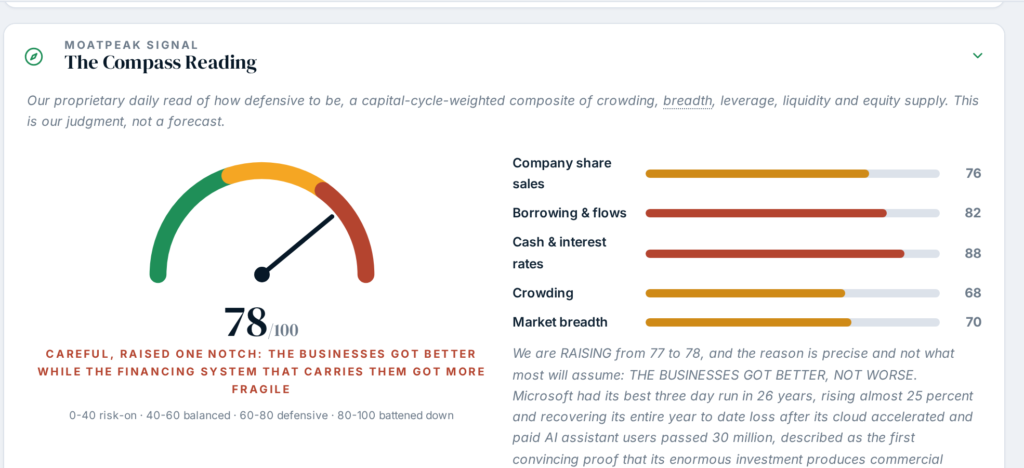
To be fair to the optimists, the companies themselves really did improve this week. Microsoft had its best three-day run in 26 years and recovered all its losses for the year, as investors finally saw its big AI investments pay off. Palantir’s revenue grew 93 percent, and its American commercial business rose 149 percent. These aren’t just stories; they’re real results.
That’s why this perspective is useful. This isn’t about overpriced shares in weak companies. It’s about strong companies with expectations that have gone beyond even their impressive results. When you check if something is expensive, don’t stop at the multiple. Ask what the multiple is based on. A reasonable price built on a bold forecast is riskier than a high price based on modest expectations, because the risk is hidden where you might not notice.
We discuss the specific forecasts we believe are being stretched, and what might change our view, in today’s Compass.
Read at https://moatpeak.com
Educational research only. Not personalized investment advice. MB “MoatPeak Group”.
Get the Weekly Explainer
The biggest market story explained, every week. Free, by email.
Explore the research library
Company, industry and market reports with sources, charts, possible outcomes and the full evidence.
More free explainers
Markets, companies, portfolio basics and investing foundations. All free articles.
Back to Learn