

Markets just had their biggest net buying day since November 2020. Korea jumped about 18 percent in one session, with SK Hynix up 30 percent and Samsung up 27 percent. Foreign investors added 5.1 billion dollars.
Most headlines took this as a sign that everything was fine.
But then someone did the important work. Goldman examined what really made up that record buying.
Most of the activity was short covering. This means investors who had bet against the market were forced to close those positions, which requires buying. Real new buying, as Goldman put it, was much smaller. The research called the move defensive and mechanical, not a broad wave of new money coming in.
This shows the difference between two things that look the same but act very differently.
A squeeze happens when there are no more sellers. A recovery happens when new buyers come in. On a chart, both look like the same green candle. But underneath, a squeeze has limited fuel, while a recovery can build on itself.
A squeeze ends as soon as the last short seller has bought back. After that, the price needs real buyers who want to own the stock. In a recovery, each new buyer encourages more people to buy.
Korea is a perfect example. No market truly becomes 18 percent more valuable in a single day. The underlying businesses did not change by 18 percent between Friday and Monday. That jump tells us about investor positioning, not real value.
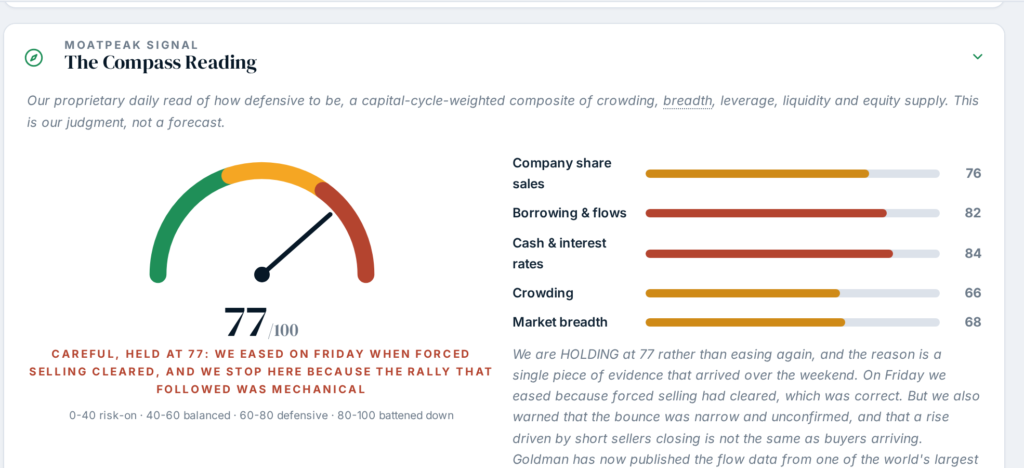
This is why we stay cautious instead of feeling relieved. The borrowing is still there. Even after all the changes in July, total borrowing in global investment strategies is near the 98th percentile of its history, higher than almost any other time. Leveraged funds reduced about 170 billion dollars of exposure in one month, but it is still close to a record.
It gets more concerning. Hidden exposure to chip stocks through private swap contracts may still be over 100 billion dollars. These do not show up in public data, since the bank holds the shares, not the investor. No one knows the real number, not even those who need to.
To be fair, the fundamentals are actually strong. Around 86 percent of large U.S. companies beat expectations. Microsoft and Amazon both showed real demand for cloud services. Chip stocks now trade below their five-year average value, and their profit forecasts have dropped much less than their prices. That is why we still expect things to stay steady rather than fall.
Why is it important for you? When prices spike, ask whether people had to buy or wanted to buy. If they were forced, it is a mechanical event with limited momentum. In this case, the key question is what happens when it stops. If people chose to buy, that trend usually lasts longer.
Which one this is, and whether this is a squeeze or a real recovery, and the two signs we need before calling it a recovery, are covered in today’s Compass at https://moatpeak.com
Educational research only. Not personalised investment advice. MB “MoatPeak Group”.
Get the Weekly Explainer
The biggest market story explained, every week. Free, by email.
Explore the research library
Company, industry and market reports with sources, charts, possible outcomes and the full evidence.
More free explainers
Markets, companies, portfolio basics and investing foundations. All free articles.
Back to Learn