

We decided to do it ourselves.
The test is straightforward, and you do not need a finance background to understand it.
A lot of money has been spent on chips, data centers, and power. Like any factory, that investment needs to make a return. To check this, add up the capital spent, figure out the yearly revenue needed for a normal return, and compare it to what the AI industry can realistically sell.
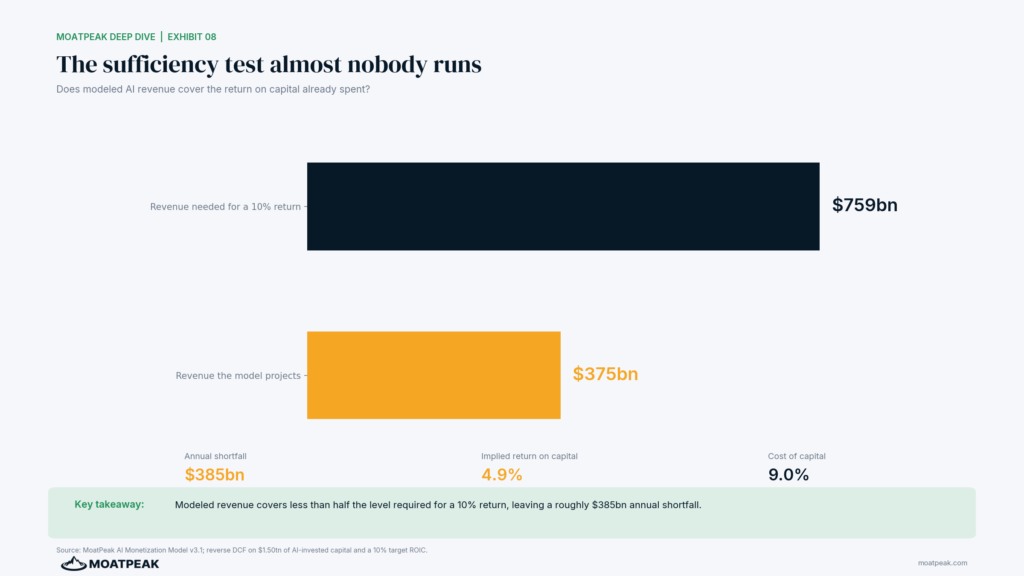
Based on our calculations, about $1.5 trillion invested in AI would need to generate around $759 billion in yearly revenue to achieve a 10% return.
We estimate that the entire AI sector could actually sell about $375 billion. This is a generous figure. It includes global sales, not just those in America. It also counts budgets moving from older software, cloud services, and outsourcing, as well as new categories that did not exist before.
That amount covers only 49% of what is needed.
This means the return on that capital is 4.9%, while the cost of capital is about 9%. That leaves a gap of around $385 billion each year.
Here is something we want to make clear, since it is easy to misunderstand.
We are not saying that AI is a failure. Our point is more specific and, we believe, more helpful: a technology can work exactly as promised but still not earn back the money invested in it. This happened with railways and with fiber optics in 2000. The trains ran and the internet worked, but not everyone who financed the tracks and cables got paid.
There is also a reason this gap could be smaller than we have shown, and we want to be open about it. Every number here is based on assumptions. If AI providers capture more value than we expect, if the total investment is closer to $1 trillion instead of $1.5 trillion, or if global demand grows faster, the outcome could improve quickly. The specialists who remain get more expensive as fast as headcount falls, the labor-saving channel shrinks towards nothing, and so does a chunk of the revenue.
What does this mean for you? When a company talks about the size of an opportunity, they are describing demand, not returns. A big market and a good investment are two different things, and only the second one brings you profit.
Read it and more at https://moatpeak.com
Educational research only. Not personalised investment advice. MB “MoatPeak Group”.
Get the Weekly Explainer
The biggest market story explained, every week. Free, by email.
Explore the research library
Company, industry and market reports with sources, charts, possible outcomes and the full evidence.
More free explainers
Markets, companies, portfolio basics and investing foundations. All free articles.
Back to Learn