

In the past few weeks, we created something we could not find anywhere else: a model that shows how artificial intelligence actually generates money. Instead of looking at market size, we focused on how value moves and who receives it.
One number stands out to us.
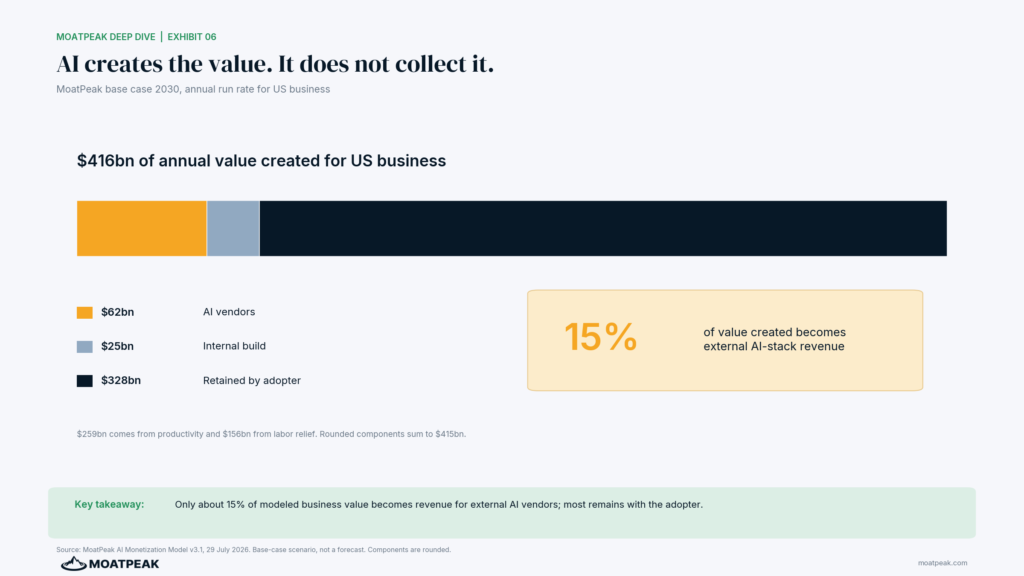
In our main scenario, by 2030, AI is expected to create about $416 billion each year in real value for American businesses. About $259 billion comes from higher output, sales, and speed, while $156 billion comes from lower wage costs than businesses would otherwise have.
Of that $416 billion, about $62 billion turns into revenue for the companies selling AI.
That means only fifteen cents of every dollar goes to AI sellers.
Roughly $25 billion is spent on internal changes, while about $328 billion stays with the companies using AI tools or is passed on to their customers through lower prices.
Many people make a common mistake. They estimate AI’s total value in the trillions and assume the companies selling AI will get all of it. That is not true. A business might gain $100 in value but only pay a small part to the model provider, cloud provider, software vendor, and integrator.
For example, think about spreadsheets. Excel created a lot of value for the world economy, but Microsoft only got a small share. The rest went to everyone who benefited from faster accounting.
We also focused on another important point. You cannot count the same productivity gain twice. If it shows up as extra output, it cannot also be counted as lower wage costs. Our model separates these effects and then figures out how much of each becomes business profit or AI industry revenue. Many published estimates quietly double-count these gains.
What does this mean for you? When you see a big number about a new technology, ask a second question before acting on it. Instead of only asking how much value it will create, ask who can actually charge for it. These are different questions, and the gap between them is where much of the money disappears.
Read it and more at https://moatpeak.com
Educational research only. Not personalised investment advice. MB “MoatPeak Group”.
Get the Weekly Explainer
The biggest market story explained, every week. Free, by email.
Explore the research library
Company, industry and market reports with sources, charts, possible outcomes and the full evidence.
More free explainers
Markets, companies, portfolio basics and investing foundations. All free articles.
Back to Learn