

Most news outlets barely mentioned it, but this story deserves more attention for reasons that go beyond oil.
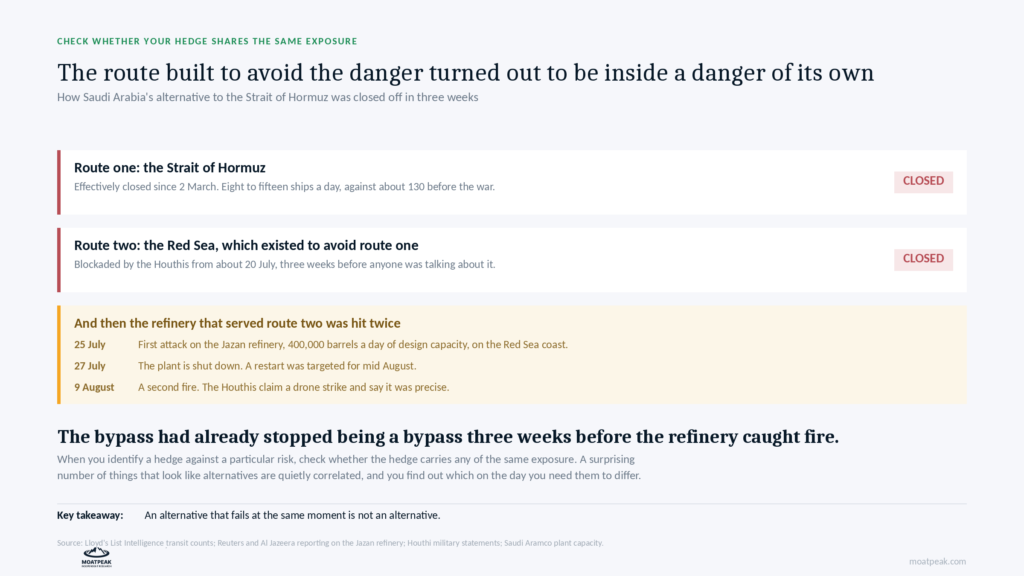
Let’s look at the problem this refinery was supposed to address. Since early March, the Strait of Hormuz has been almost closed. Only eight to fifteen ships pass through each day, compared to about 130 before the war. This is the most important chokepoint in the energy system, and it has been closed for five months.
The solution everyone talked about was Saudi Arabia’s refinery at Jazan, on the Red Sea coast. It can handle 400,000 barrels a day. The whole point of this plant is to let Saudi Arabia refine and export petroleum products without using the Strait of Hormuz. Any analyst who said Saudi Arabia had options was really talking about this plant and this coastline, even if they didn’t say it directly.
Here is the timeline that nobody has assembled in one place.
Around July 20, the Houthis announced a blockade of Saudi ports and the southern Red Sea. That’s when the alternative route stopped working, and it happened without much notice.
On 25 On July 25, the refinery was attacked. Two days later, it was shut down, with plans to restart in mid-August. On August 9, it caught fire again. The Houthis claimed responsibility for a drone strike and said it was accurate. The alternative route had already failed three weeks before the plant that served it was hit. The hedge was compromised before the headline arrived.
The real lesson here goes beyond oil.
When you set up a hedge against a risk, make sure it doesn’t have the same weaknesses as what you’re trying to protect. People hold two assets they believe are alternatives, and the two turn out to depend on the same weather. Gold and gold miners are not the same trade until a mining strike says otherwise. Two banks in different countries are not diversified if they fund themselves in the same market. A backup supplier is not a backup if it buys from your main supplier.
There’s a simple, if tedious, test that many people skip. For each pair of investments, ask yourself what single event could hurt both. If you can think of one, you have less protection than you thought.
In this case, the single event was a group of drones that could reach both the Gulf and the Red Sea. This risk was knowable ahead of time, but it wasn’t factored into the price.
To be clear, this isn’t an immediate crisis. Jazan is small compared to Saudi Arabia’s total capacity, and the country’s crude exports aren’t affected by this one plant. We’re not turning a fire into a crisis. What has changed is the insurance and logistics costs for the alternative route. These changes may not make headlines, but they are likely to last.
Today’s comprehensive research is available at https://moatpeak.com
Educational research only. Not personalized investment advice. MB “MoatPeak Group”.
Get the Weekly Explainer
The biggest market story explained, every week. Free, by email.
Read the complete Member report
Sources, charts, possible outcomes and the full evidence behind this article.
Then $19/month. Cancel online before the trial ends.
More free explainers
Markets, companies, portfolio basics and investing foundations. All free articles.
Back to Learn