


Berkshire Hathaway is buying its own stock again, and in size.
In the third quarter, Berkshire spent $9.6 billion on its shares, after $4.5 billion in the second quarter and nothing in all of 2025. That brings the 2026 total to $14.4 billion. Many investors read a Berkshire buyback as a buy signal. The price matters. From the share counts and cost in its quarterly report, we estimate Berkshire paid about $503 per Class B share on average in the third quarter. On 6 November, the last close before the report, the shares finished at $570.89, 13.6 percent higher.
What the buyback rule says
Berkshire repurchases shares when its chief executive, after consulting the chairman, believes the price is below its conservatively determined intrinsic value. It will not buy if cash, equivalents and Treasury bills would fall below $30 billion. At the end of September, that pile was about $357 billion, net of Treasury bill purchases still to settle.
The third-quarter buybacks tell you that Berkshire’s managers thought the stock was worth more than about $503. They tell you less about $571.
The buying continued after the quarter ended. The report lists the shares outstanding on 28 October, and the count fell by the equivalent of 3.8 million Class B shares from 30 September. At October’s average close of $525, that is roughly $2 billion of stock, bought in a month when the price ranged from $500 to $549.
Where Berkshire buys
History helps here. We compared each quarter’s average share price with Berkshire’s book value per share since the third quarter of 2018. In 2020 and 2021, when Berkshire bought $51.7 billion of stock, it paid an average of 1.27 times book. It stopped buying in mid-2024, when the ratio climbed past 1.5, and resumed this year as the shares slipped back toward 1.4. The third quarter averaged 1.43 times book and October about 1.47. At $570.89, the stock trades at 1.60 times the $357.73 book value per Class B share.
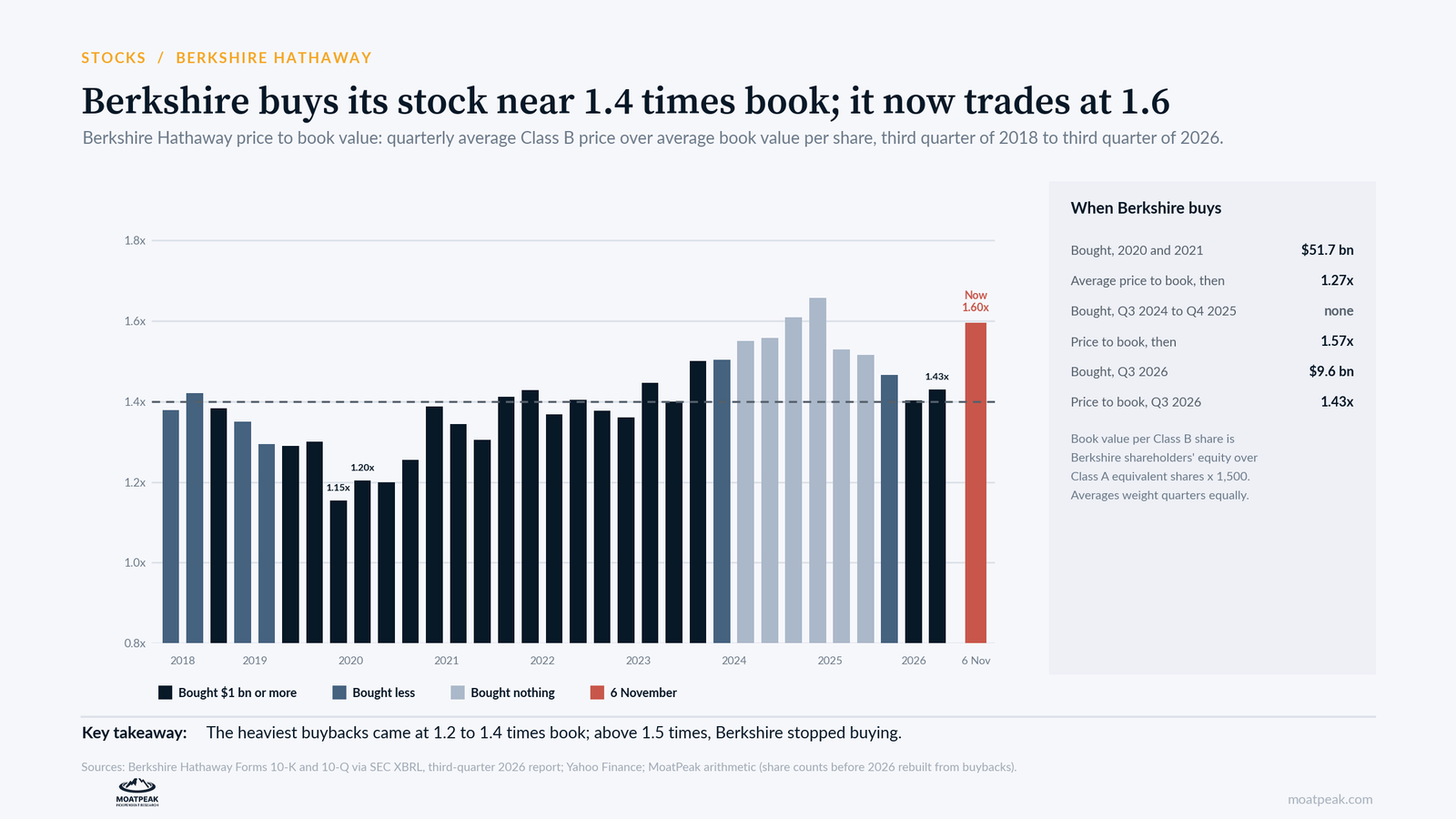
Book value understates what Berkshire’s operating businesses are worth, so treat the ratio as a yardstick for comparing periods. On that yardstick, the market price has moved above Berkshire’s own buying range.
What the quarter showed
Operating earnings fell 5.8 percent to $12.7 billion. Most of that was currency. Excluding exchange rate effects on its non-dollar debt, operating earnings were about 0.8 percent lower. Underneath, the mix shifted. BNSF earned 19 percent more and the manufacturing, service and retailing businesses 12 percent more, while insurance underwriting profit fell 43 percent. GEICO’s combined ratio rose to 91.4 percent from 84.3 percent as claims costs climbed and average premiums per policy fell.
Our read
The buyback is a vote of confidence at 1.4 to 1.5 times book, and Berkshire’s managers have been consistent about what they will pay. At 1.6 times, we would wait. The third quarter does not support paying a higher multiple than Berkshire paid itself: operating earnings were roughly flat after currency effects, and insurance profits fell.
The case against us
Berkshire judges buybacks against intrinsic value, which book value understates, so its managers may see value above 1.6 times book that the ratio misses. The cash is an option as well: about $357 billion that could fund a large acquisition at a good price in a selloff. And by our arithmetic, book value per share has compounded at about 11 percent a year over the past five years.
What it means for your money
- Use Berkshire’s price as your anchor. The company has bought at up to about 1.5 times book; on current book value, that is roughly $537 a share.
- Do the return math at your price. If book value per share keeps growing 11 percent a year and the multiple drifts back to 1.4, a buyer at 1.6 times earns about 8 percent a year over five years.
- Watch the share count. The fourth-quarter report will show whether Berkshire kept buying above $550.
What we are watching
- The annual report in late February: the full-year buyback total and any change in how management describes intrinsic value.
- GEICO’s combined ratio: whether claims costs keep outrunning premiums.
- The cash pile: whether Berkshire puts more of its $357 billion to work.
Educational research only. Not personalized investment advice. MB “MoatPeak Group”.
Get the Weekly Explainer
The biggest market story explained, every week. Free, by email.
Explore the research library
Company, industry and market reports with sources, charts, possible outcomes and the full evidence.
More free explainers
Markets, companies, portfolio basics and investing foundations. All free articles.
Back to Learn