


For years, the biggest technology companies were among the largest buyers of their own shares. In 2023 and 2024, Alphabet alone spent about $15 billion a quarter on buybacks, and Meta often spent more than $5 billion.
That has mostly stopped. The AI build-out now costs more than these companies generate, and they are filling the gap with new stock and new debt.
From buying to selling
We added up the cash flow statements of the five biggest AI spenders: Alphabet, Amazon, Meta, Microsoft and Oracle. In their latest quarter (July to September, or June to August for Oracle), they spent $4.4 billion on buybacks, all of it at Microsoft. Two years earlier, they spent $28.4 billion. At the peak, in January to March 2024, they spent $35.4 billion.
Alphabet bought back no shares in the first nine months of 2026, after $39.8 billion a year earlier. Instead, it raised $42.9 billion by selling common stock and $19.1 billion through mandatory convertible preferred shares. Oracle sold $19.9 billion of stock through an at-the-market program from June to August. Meta has made no buybacks this year, after $26.2 billion a year earlier. Amazon made no buybacks and raised $115.1 billion of long-term debt in nine months, against $0.7 billion a year earlier.
Where the cash goes
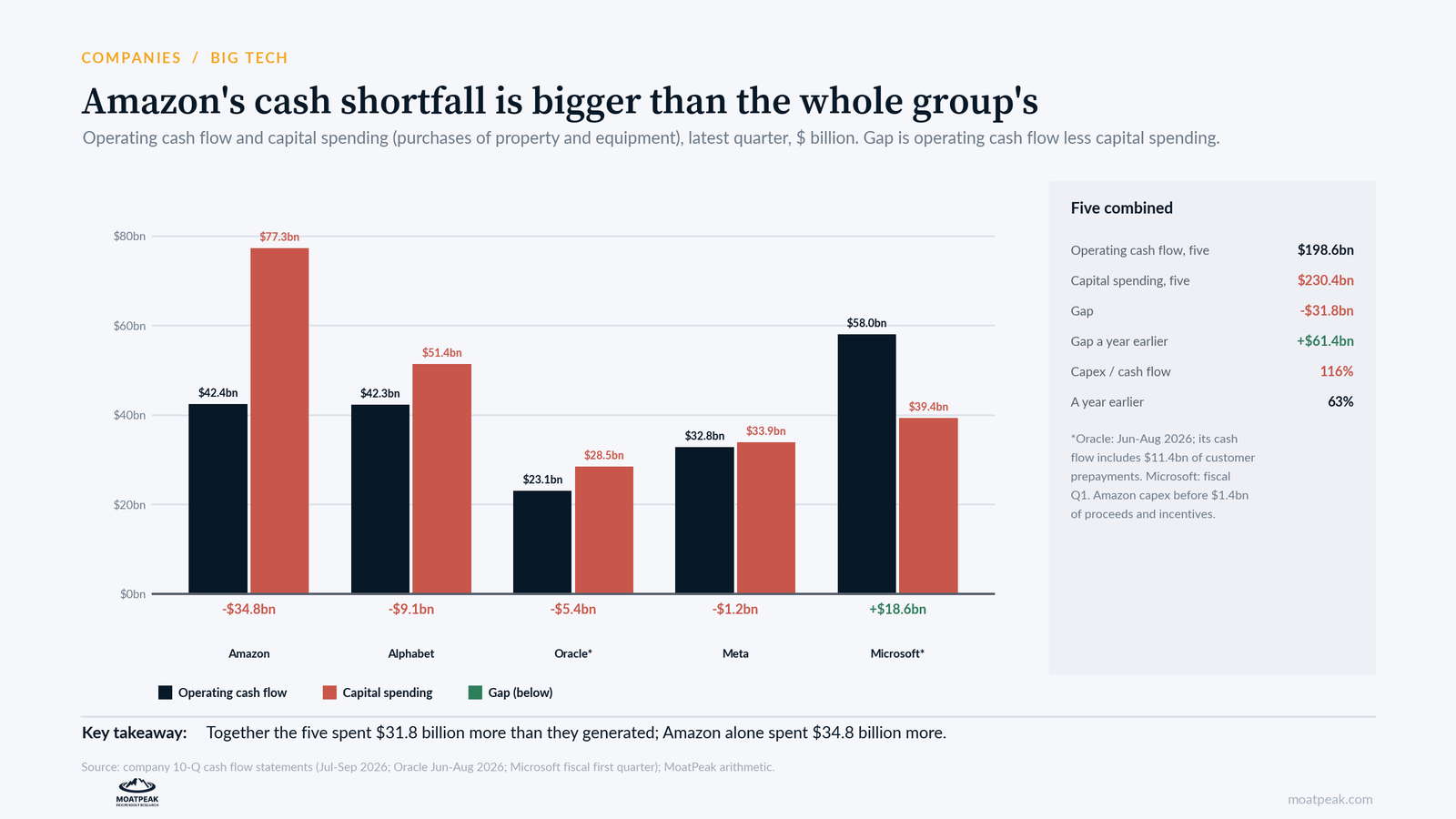
In the latest quarter, the five generated $198.6 billion of operating cash flow and spent $230.4 billion on property and equipment such as data centers and servers. That left a $31.8 billion gap. A year earlier, they had a surplus of $61.4 billion. Capital spending has more than doubled in a year, while operating cash flow rose 19 percent.
The gap is concentrated. Amazon spent $77.3 billion against $42.4 billion of operating cash flow, a shortfall of $34.8 billion, larger than the group’s total. Alphabet’s gap was $9.1 billion, Oracle’s $5.4 billion and Meta’s $1.2 billion. Microsoft is the exception, with $18.6 billion more cash than it spent.
Oracle’s cash flow also looks better than it is. It includes $11.4 billion of customer prepayments, money paid up front for future service that carries a significant financing component.
Our read
We read this as a change in who funds the AI build-out. Big Tech used to return cash to shareholders; now two of the five sell stock to fund the build-out, and the group borrows. Only Microsoft still buys back stock, while new shares add to supply.
For shareholders, this changes the arithmetic. When a company sells stock, earnings per share grow more slowly than profits. The return on the new data centers will decide whether the dilution pays off, and that return is not yet visible in the numbers.
The case against us
The gap is a choice. Operating cash flow at the five is growing quickly, and they could slow spending if returns disappoint. Microsoft funds its spending from its own cash, and the others have shown they can borrow at scale.
Selling stock can also be sound. If a company believes its shares are richly valued, selling stock is the mirror image of buying it back when it is cheap. Alphabet also booked $126.8 billion of gains on its investments in the first nine months.
What it means for your money
- Read the per-share numbers. With buybacks gone and new stock issued, earnings per share can lag net income at Alphabet and Oracle.
- Separate the self-funders from the borrowers. Microsoft covers its spending from operations; Amazon borrowed $115 billion this year to keep building.
- Check the financing section of each cash flow statement. Buybacks, stock issued and debt raised show how the build-out is being paid for.
What we are watching
- Oracle’s results in December: whether it sells more stock and how far capital spending exceeds cash flow.
- Full-year reports in early 2027: total 2026 buybacks against stock sold, and capital spending plans for 2027.
- Bond issuance by the five: whether borrowing keeps pace with the cash gap.
Educational research only. Not personalized investment advice. MB “MoatPeak Group”.
Get the Weekly Explainer
The biggest market story explained, every week. Free, by email.
Explore the research library
Company, industry and market reports with sources, charts, possible outcomes and the full evidence.
More free explainers
Markets, companies, portfolio basics and investing foundations. All free articles.
Back to Learn