

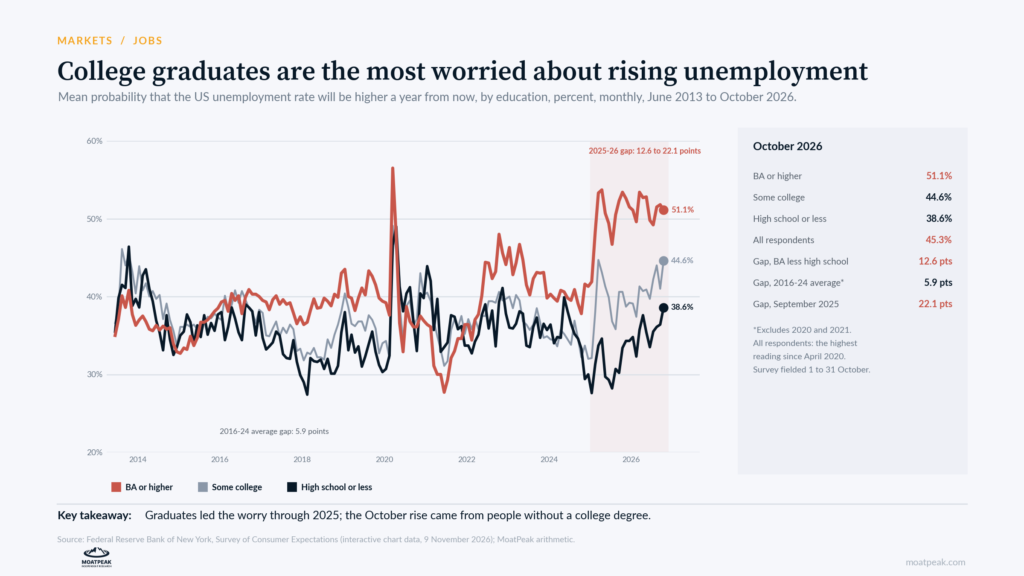
Americans now put higher odds on rising unemployment than at any time since April 2020.
In the New York Fed’s October consumer survey, the average respondent put the chance that the US unemployment rate will be higher in a year at 45.3 percent. By education, college graduates were the gloomiest, at 51.1 percent. People with a high school education or less put it at 38.6 percent.
The timing is odd. Weekly claims for unemployment benefits fell to 189,000 in the week to 31 October, matching July’s low, the lowest since 1969. The unemployment rate was 4.1 percent in October.
Who is worried
Graduates have been gloomier than people with a high school education or less for most of the past decade, by about 6 points on average from 2016 to 2024, excluding the pandemic years. In 2025, the gap tripled to 19 points. It peaked at 22.1 points in September 2025 and has since narrowed to 12.6.
The October rise came from people without a degree. Among those with a high school education or less, the reading rose to 38.6 percent from 36.4 percent. Among those with some college, it rose to 44.6 percent from 41.0 percent. Graduates’ reading slipped to 51.1 percent from 51.8 percent.
Has the worry been right?
A survey of fears is useful only if the fears come true. We checked every survey month from June 2013 to October 2025 against what the unemployment rate did over the following year. We left out start months from March 2019 to June 2021, so the pandemic shock does not drive the result.
For the survey as a whole, the answer is no. In the fifth of months when people were most worried, the unemployment rate fell by an average of 0.25 points over the next year. In the calmest fifth, it fell by 0.40 points. Worry and outcomes barely lined up.
For graduates, the record is better. When their worry was in its top fifth, the jobless rate for people with a bachelor’s degree or more rose by an average of 0.10 points over the next year. When it was in its bottom fifth, that rate fell by 0.46 points. The year 2025 was the clearest case. Graduates turned gloomy early in the year, and their unemployment rate climbed from 2.3 percent in January 2025 to 3.0 percent in January 2026, the highest since July 2021.

Since January 2026, the graduate jobless rate has eased back to 2.6 percent. Their worry has stayed between 47 and 54 percent since March 2025.
Our read
We read the October survey as less alarming than its headline. The measure that just hit a six-year high has not been a useful forecast of the jobless rate. The measure that has been useful, graduates’ worry, has stopped rising, and their own unemployment rate has fallen for most of this year. The new worry sits with people without a degree. In our test, the worry of people with a high school education or less had no link to their own jobless rate either.
The survey does not say why graduates turned so gloomy in early 2025. The timing fits the spread of AI tools into office work, but the data cannot prove it.
For markets, spending plans matter more than mood. Households still expect their spending to grow 5.3 percent over the next year, above the 12-month average of 5.0 percent. So far, the worry has not shown up in spending plans.
The case against us
The survey starts in 2013, a period with one recession, and that one came from a virus. Thirteen years of a mostly growing economy is a short test. A reading that missed the small moves in unemployment could still catch a real turn.
Stress is also building in other answers. The average chance of missing a minimum debt payment over the next three months rose to 13.8 percent, the highest since December 2025. Expected pay growth of 2.6 percent trails expected inflation of 3.9 percent, so people expect their real income to shrink.
What it means for your money
- Do not trade the headline. In our test, the most worried fifth of months was followed by falling unemployment, on average.
- Watch the graduate jobless rate. It comes out with each monthly jobs report, and graduates are the group whose worry has carried information. A move back toward 3 percent would matter more than another survey high.
- Follow spending plans and debt stress together. If spending expectations fall while the odds of missed payments rise, worry is turning into behavior. Companies that sell to households would feel it first.
What we are watching
- Weekly jobless claims, every Thursday: whether claims stay near their lowest level since 1969.
- The November jobs report, 4 December: the graduate unemployment rate against October’s 2.6 percent.
- The November consumer survey in December: whether worry keeps rising among people without a degree.
Educational research only. Not personalized investment advice. MB “MoatPeak Group”.
Get the Weekly Explainer
The biggest market story explained, every week. Free, by email.
Explore the research library
Company, industry and market reports with sources, charts, possible outcomes and the full evidence.
More free explainers
Markets, companies, portfolio basics and investing foundations. All free articles.
Back to Learn