

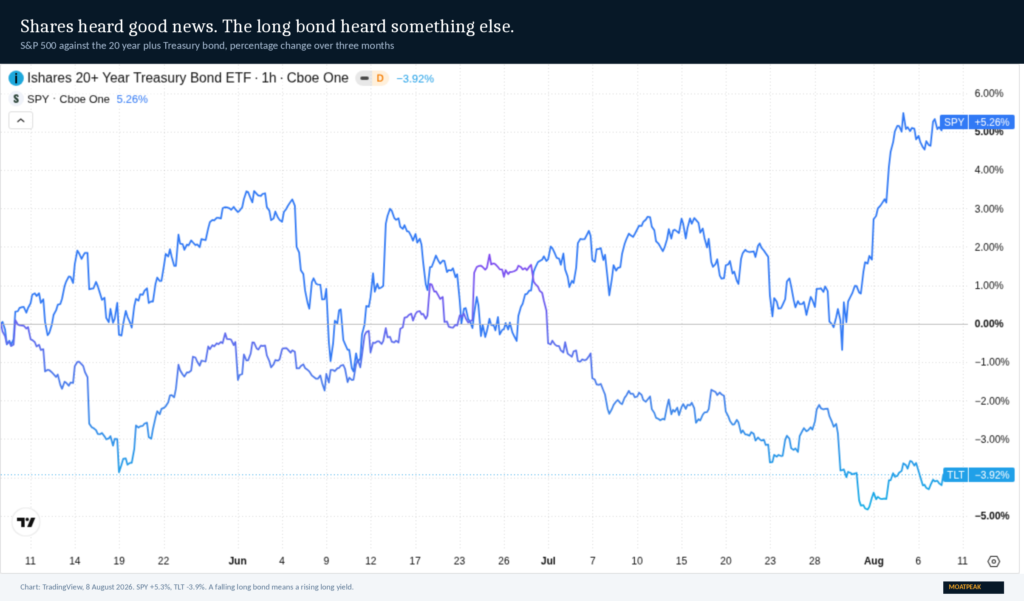
Within an hour, everyone had the same explanation. Weak job numbers make it less likely the central bank will raise interest rates. Lower rates usually push share prices higher. In this case, bad news seems like good news.
But there’s a problem with that logic, and you can spot it easily on any chart.
In the last three months, the S&P 500 has climbed about 5 percent, while long-term Treasury bonds have dropped around 4 percent over the same period.
When bond prices fall, yields go up. So even as stocks were rising, borrowing money for the long term was getting more expensive.
And this rise has happened because of weak economic data, not st This detail is key. If inflation were the main issue, weak economic data would push long-term yields down. Slower growth usually means less pressure on prices and less need for high rates. But that’s not what we’re seeing.
When long-term yields go up even as the economy slows, it’s not about inflation. It’s about a shortage of long-term capital. There are too many borrowers, including governments, chasing long-term money, but not enough is available at today’s rates. So the price goes up, no matter what’s happening with growth.
This difference might seem theoretical, but it matters when you look at share prices.
A stock’s value comes from its future cash flows, adjusted to today’s value. Two things affect this: the size of those cash flows and the discount rate. The idea that ‘bad is good’ assumes that lower rates matter more than weaker earnings. So even if the economy slows, cheaper money is expected to boost share prices.
But this only works if the central bank controls the discount rate.
If the discount rate is really being set by how much long-term capital is available, then even if the central bank tries to keep rates low, long-term rates might not drop. That means you get weaker earnings, but not the benefit of lower rates.
That’s the worst possible outcome, not the best.
To be fair, this debate isn’t settled. Long-term yields can rise for good reasons, like hopes for stronger growth, and if oil prices keep falling, that could help too. It’s possible that the optimists will be right over the next six months.
But right now, the idea that weak data will save expensive stocks assumes the bond market is wrong about something it usually understands best.
What does this mean for you? When two markets react differently to the same news, don’t just trust the one making the most noise. Think about which market needs to be right for you to benefit. Stock investors get rewarded for optimism. Bond investors get paid for being right about getting their money back.
Our full read, and the level in long-term yields that would change it, is in this week’s research.
Read it at https://moatpeak.com
Educational research only. Not personalized investment advice. MB “MoatPeak Group”.
Get the Weekly Explainer
The biggest market story explained, every week. Free, by email.
Explore the research library
Company, industry and market reports with sources, charts, possible outcomes and the full evidence.
More free explainers
Markets, companies, portfolio basics and investing foundations. All free articles.
Back to Learn