

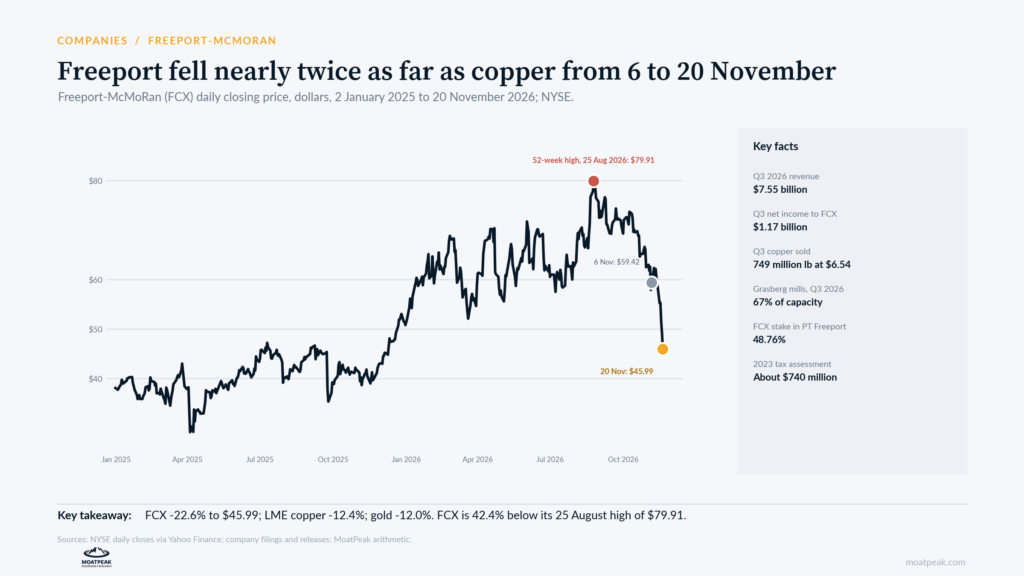
Freeport-McMoRan closed at $45.99 on 20 November, down 22.6 percent from $59.42 on 6 November and 42.4 percent below its 25 August high. Over the same two weeks, the London Metal Exchange cash price of copper fell 12.4 percent, from about $6.33 to $5.55 a pound, and the London gold price fell 12.0 percent. Freeport mines copper, gold and molybdenum in the Americas and in Indonesia, home of its Grasberg copper and gold district.
A miner’s shares fall faster than its metal because its costs stay put. In the third quarter, Freeport spent $2.07 to produce a pound of copper, after credits for the gold and molybdenum from the same ore and before $244 million of idle and repair costs at Grasberg. At the exchange price, that leaves a cash margin of about $4.26 a pound on 6 November and $3.48 on 20 November: 18 percent less margin from a 12 percent fall in copper.
What the company sells
In the quarter to 30 September, Freeport sold 749 million pounds of copper at an average of $6.54 a pound, along with 105,000 ounces of gold and 22 million pounds of molybdenum, a metal that hardens steel. Revenue was $7.55 billion and net income for shareholders was $1.17 billion.
Its accounts count every pound from Grasberg, Cerro Verde and El Abra, but it owns 48.76 percent of PT Freeport Indonesia (which runs Grasberg), 55.66 percent of Cerro Verde in Peru and 51 percent of El Abra in Chile. Partners own the rest.
What the price is betting on
At $45.99, the market values Freeport at about $66 billion. That price rests on two things: copper well above the $4-a-pound level at which Freeport says its Arizona expansion breaks even, and the return of Grasberg. A sudden flood of wet mud into the underground mine cut its output sharply from September 2025. In the third quarter of 2026, the Indonesian mills ran at 67 percent of capacity. The company expects about 80 percent by mid-2027 and close to full capacity by the end of 2027, with copper sales rising from 3.0 billion pounds in 2026 to 4.1 billion in 2028.
What we think the market is missing
The recovery is real, and a large part of it belongs to someone else. Freeport’s own estimates put partners’ share of copper sales at 0.81 billion pounds in 2026 and 1.27 billion in 2028. Of the extra 1.1 billion pounds, about 42 percent goes to partners. For gold, partners get more than half of the increase. Under a preliminary agreement that would extend its Indonesian mining rights beyond 2041, Freeport’s stake falls to about 37 percent from 2042.
Two new claims on the cash arrived within weeks. In October, Indonesia’s tax authorities sent PT Freeport Indonesia assessments of about $740 million for 2023, which it plans to contest. On 4 November, the board approved a $4.5 billion expansion at Bagdad in Arizona, with first output in mid-2030. Freeport classifies Bagdad as discretionary, which keeps it out of the cash-flow measure behind its variable dividend and buybacks. The money is still spent, with about 80 percent of it falling in 2028 to 2030.
What sets the share’s value is copper after this cycle and the cash that reaches Freeport after partners, taxes and building costs. Two weeks of spot prices matter less than the selloff suggests.
What would prove us wrong
- Copper stays scarce. Freeport says over 65 percent of the world’s copper goes into products that carry electricity. That demand could hold prices well above past cycles.
- Cheap copper from old piles. New leaching methods, which pull more metal from stockpiled ore, are to yield 300 million pounds in 2027, up from about 220 million a year.
- Indonesia settles well. It drops the 2023 tax claim and issues the extended license on the agreed terms.
What to watch
- 24 November: PT Freeport Indonesia’s $750 million of 6.90 percent notes due 2033 settle, to refinance existing debt.
- Late January 2027: fourth-quarter results. In 2026, it reported on 22 January. The test is sales of 875 million pounds of copper and 300,000 ounces of gold.
- Early 2027: upgrades to the ore-handling system in the Grasberg Block Cave mine are due to finish.
- Mid-2027: about 80 percent of capacity and the restart of Production Block 1S, a section still under repair in October.
- End of 2027: close to full capacity.
For members: our verdict, the price test and what would change our mind are in the full report.
Educational research only. Not personalized investment advice. MB “MoatPeak Group”.
Get the Weekly Explainer
The biggest market story explained, every week. Free, by email.
Explore the research library
Company, industry and market reports with sources, charts, possible outcomes and the full evidence.
More free explainers
Markets, companies, portfolio basics and investing foundations. All free articles.
Back to Learn