

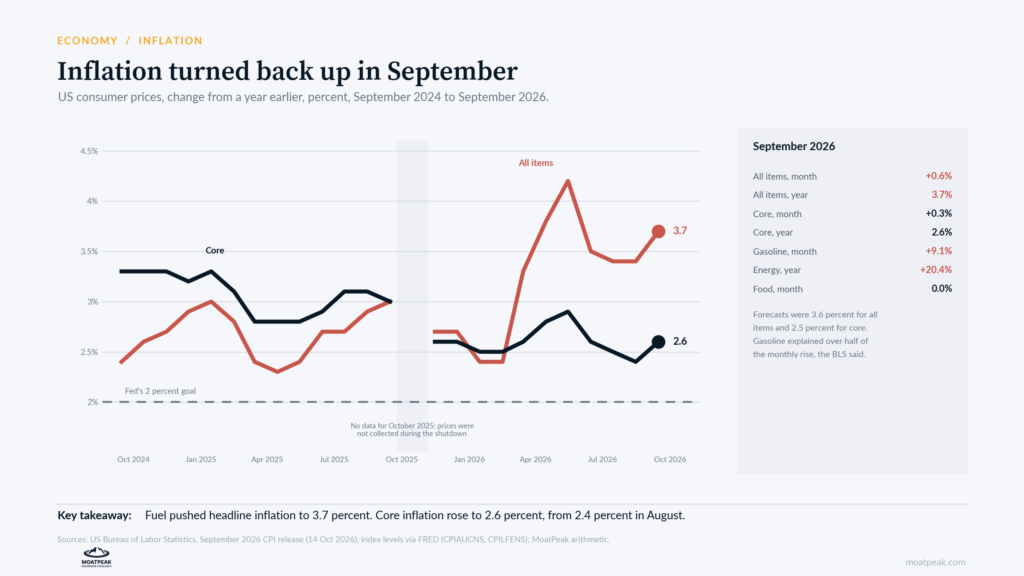
US consumer prices rose 0.6 percent in September and 3.7 percent from a year earlier, the Bureau of Labor Statistics said on Wednesday. Forecasters had expected 3.6 percent. Core prices, which leave out food and energy, rose 0.3 percent on the month and 2.6 percent on the year, against forecasts of 0.2 and 2.5 percent.
In a Note before the release on Wednesday, we wrote that a core reading of 0.3 percent or more would suggest higher fuel costs were spreading into other prices. It came in at exactly 0.3 percent, the same as in August, and the yearly core rate rose from 2.4 percent to 2.6 percent.
Fuel did most of the work
Gasoline prices rose 9.1 percent in September and accounted for more than half of the monthly increase, the BLS said. Energy prices are now 20.4 percent higher than a year ago. Gasoline is up 34.2 percent and heating oil 74.2 percent. Food prices were flat on the month.
Where it is spreading
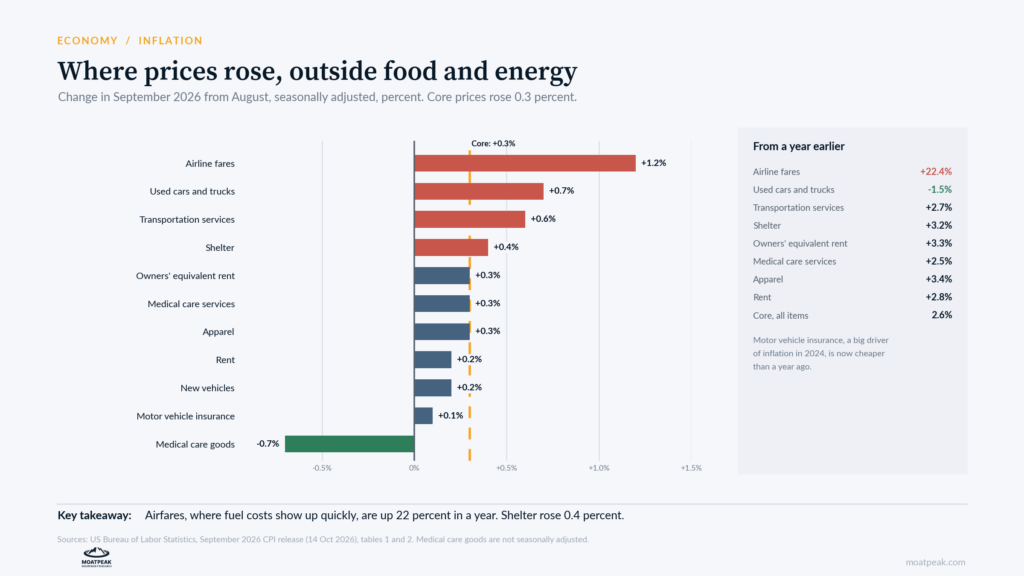
Outside food and energy, the clearest sign of fuel costs is in travel. Airline fares rose 1.2 percent in September and are up 22.4 percent from a year earlier. Transportation services as a whole rose 0.6 percent.
Shelter, the biggest single item in the core index, rose 0.4 percent after 0.3 percent in August. Used cars rose 0.7 percent. On the other side, motor vehicle insurance, a big driver of inflation in 2024, rose just 0.1 percent and is 5 percent cheaper than a year ago. Medical care goods fell 0.7 percent.
What it means for the Fed
The Fed raised its key rate on 16 September, to a range of 3.75 to 4 percent. Futures markets moved quickly after Wednesday’s report. By the afternoon, the chance of another increase at the 27 and 28 October meeting had risen to roughly 33 percent, from 22 percent on Tuesday, according to CME FedWatch data reported by CNBC. Two-year Treasury yields, which move with expectations for Fed rates, jumped to their highest level since 29 September, then fell back to about 4.80 percent, little changed on the day.
In plain terms, a rate rise that looked unlikely on Tuesday is now a real possibility. Futures put the chance of at least one more increase by December at about 90 percent.
The case against us
One month is not a trend. Core prices also rose 0.3 percent in August, and the yearly core rate of 2.6 percent is still below the 2.9 percent of May. Fuel-driven jumps can also fade quickly. Headline inflation fell from 4.2 percent in May to 3.5 percent in June. And the 2025 government shutdown left a gap in the data for October 2025, which still affects some comparisons.
What it means for your money
- Short-term savings still beat inflation, just. Three-month Treasury bills yielded about 4.3 percent on 13 October, against inflation of 3.7 percent.
- Watch the pump. Gasoline explained more than half of September’s rise. If it keeps climbing, so will headline inflation.
- Rate-sensitive assets are most exposed. Another rate rise would weigh first on long bonds, housing and heavily indebted companies.
What we are watching
- 15 October, 14:30 Brussels time: producer prices and retail sales for September, two of the last big data releases before the Fed meets.
- 28 October: the Fed’s decision, at the end of its two-day meeting.
- 8 and 9 December: the Fed’s last meeting of the year.
Educational research only. Not personalized investment advice. MB “MoatPeak Group”.
Get the Weekly Explainer
The biggest market story explained, every week. Free, by email.
Explore the research library
Company, industry and market reports with sources, charts, possible outcomes and the full evidence.
More free explainers
Markets, companies, portfolio basics and investing foundations. All free articles.
Back to Learn