

Right now, whenever people talk about China and technology, they focus on artificial intelligence: cheap models, free releases, and pressure on Western prices. That story is important and it does matter.
But that’s only a small part of the bigger picture.
Here’s a number that most people missed. Economists talk about ‘capital goods,’ which just means the machines that make other products, like factory equipment and parts inside trains and trucks. Since 2005, China’s share of global exports in these goods has jumped from 7% to 24%. At the same time, Europe’s share dropped from 54% to 43%.
In other words, Europe lost about as much as China gained.
And the fastest gains are not in anything you would see on a magazine cover. Rail brakes. Engines for commercial vehicles. Industrial machinery. The unglamorous components sitting inside trains, lorries and factories that nobody thinks about until they stop working.
On top of that, one research desk’s latest read has Chinese domestic brands now holding around 60% of China’s own market for factory robots and automation, pushing aside Western suppliers who owned that market for decades. We can’t check that figure independently, so treat it as their number rather than fact. It points the same way as the export data, which we can check.
Now hold all of that against what the market says about China. Slowing economy. Broken property market. Stalling growth. That story is not wrong. Those things are true.
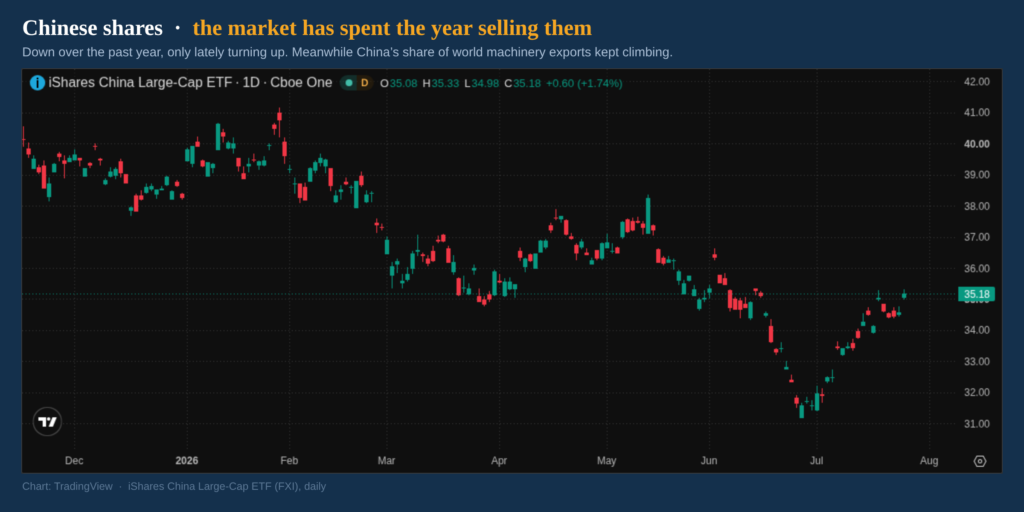
And look at the chart. Shares in China’s largest companies have fallen over the past year, bottoming out in July and only recently turning up. So the market has spent a year selling China, while China’s share of world machinery exports kept climbing. Those two facts sit side by side and almost nobody puts them in the same sentence.
They aren’t the same question. A country can be a disappointing economy and a winning manufacturer at the same time. Most investors only price the first, because the first shows up in headlines and growth forecasts, while the second shows up slowly, in trade statistics nobody reads, one dull component at a time.
But there’s a real challenge pushing back: the trade war. Shipping from China to the U.S. is down about 23% from last year and continues to fall, while shipping costs have jumped. This could seriously disrupt the trend, and it’s not a minor risk. That’s why it’s important to be cautious about this outlook.
What does this mean for you? When you think about investing in a country, try to separate two questions that often get mixed together: Is the economy strong? And are its companies succeeding globally? These can have different answers for a long time, and the difference is where opportunities or mistakes can happen.
You can find the full analysis, including which countries are quietly losing market share and what signs we’re watching to see if the trade war changes things, in today’s brief at https://moatpeak.com.
Educational research only. Not personalised investment advice. MB “MoatPeak Group”.
Get the Weekly Explainer
The biggest market story explained, every week. Free, by email.
Explore the research library
Company, industry and market reports with sources, charts, possible outcomes and the full evidence.
More free explainers
Markets, companies, portfolio basics and investing foundations. All free articles.
Back to Learn