

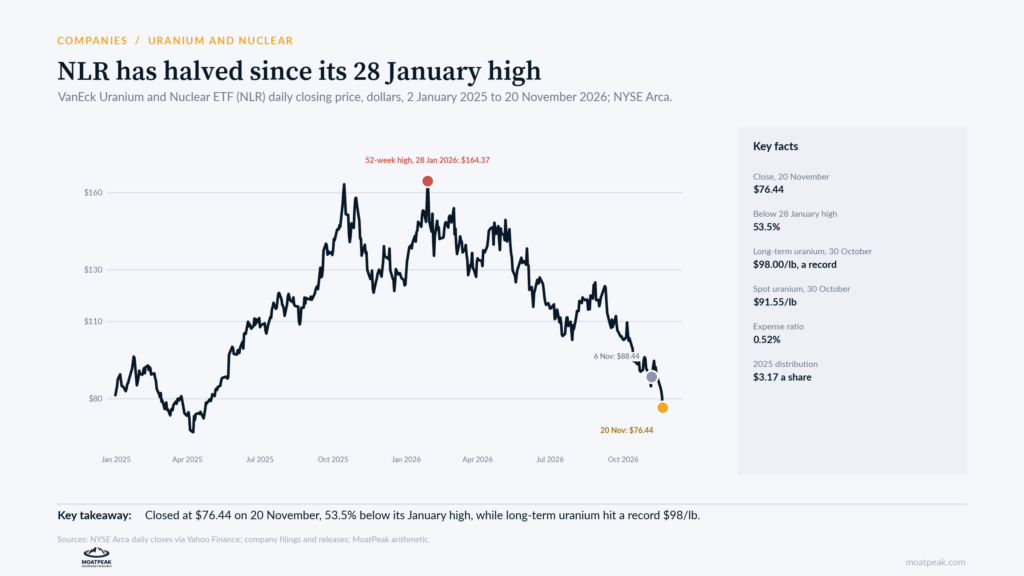
The VanEck Uranium and Nuclear ETF, ticker NLR, closed at $76.44 on 20 November. That is 13.6 percent below its 6 November close and 53.5 percent below its 28 January high of $164.37. The fund tracks an index of 25 companies across the nuclear industry, from plant operators and uranium miners to fuel suppliers and reactor developers.
A fall that large suggests the fund must be cheap. We think the halving says less than it seems, because it did not hit the holdings equally.
What the fund owns
On 20 November, the fund held four kinds of companies:
- Utilities, about 38 percent. Public Service Enterprise Group, Constellation Energy, Fortum and CGN Power run nuclear plants and sell the power.
- Uranium, fuel and equipment companies with profits, about 29 percent. Cameco, BWX Technologies and Kazatomprom are the largest.
- Physical uranium, about 4 percent. Yellow Cake, a company that stores uranium.
- Developers without profits, about 29 percent. Mine builders such as NexGen and Denison, and small-reactor companies such as Oklo, X-Energy and NuScale.
It charges 0.52 percent a year and pays one distribution in December. The 2025 payment was $3.17 a share.
On 17 February, the same four utilities made up about 19 percent of the fund. Two other utilities have since left the index, but most of the change came from prices: the utilities held their value while much of the rest fell.
What the price is betting on
NLR’s net asset value, the market value of its holdings per share, rose 55.9 percent in 2025. The bet was that data centers would need nuclear power and that a new generation of small reactors would be built to supply it. In 2026, the fund has given back most of that gain.
Uranium itself held up. Cameco’s published month-end averages put the long-term contract price at $98 a pound on 30 October, the highest in the series, up from $86.50 at the end of 2025. The spot price, for immediate delivery, was $91.55, against $81.55.
The heaviest losses were among the companies priced furthest into the future: developers without revenue and fuel suppliers valued for a rapid build-out. Several have lost two-thirds or more of their value since January, as first reactors slipped and developers sold new shares to fund themselves.
What we think the market is missing
Half the price does not mean half the valuation. The part of the fund that fell hardest is still about 29 percent of it. The part that held up, the utilities, is the largest slice, and utilities that run existing reactors tend to grow their profits slowly. A buyer after the fall gets more of the slow-growing part than a buyer in January did, plus a large stake in the part with no profits.
The fund is also a weaker uranium bet than its name suggests. Physical uranium is about 4 percent of it. Miners earn the record price only when utilities sign new long-term contracts, and much of their output is still sold under older contracts at lower prices.
The mix can move again in December, when the index has its quarterly review. The weight the utilities gained from price moves can shift back toward the rest of the fund, including the developers.
What would prove us wrong
- Developers deliver. Firm, financed reactor orders or mine financing without new share sales would lift the part with the most room to rise.
- Contracting catches up with price. Long-term uranium contracts signed in volume at record prices would raise miners’ profits faster than we expect.
- Utilities grow faster. More long power contracts with data-center operators at higher prices would lift the largest slice.
What to watch
- Mid-December: the index’s quarterly review, which can move weight from the utilities back toward the rest of the fund.
- 21 and 23 December: the 2026 distribution goes to holders who bought before 21 December and is paid on 23 December.
- January and February 2027: 2027 forecasts from the largest holdings, including Constellation, PSEG, Cameco and Kazatomprom.
- Month-end uranium prices: whether the long-term price holds near its record while contract volumes recover.
For members: our verdict, the price test and what would change our mind are in the full report.
Educational research only. Not personalized investment advice. MB “MoatPeak Group”.
Get the Weekly Explainer
The biggest market story explained, every week. Free, by email.
Explore the research library
Company, industry and market reports with sources, charts, possible outcomes and the full evidence.
More free explainers
Markets, companies, portfolio basics and investing foundations. All free articles.
Back to Learn