

Mixing up the two is a common way people lose a lot of money dYesterday, Texas made this point even more clearly than we did. than we could.
The state suspended all new data center grid connection approvals while it conducts an audit.
Let’s look at the number behind this decision, because it’s worth your attention.
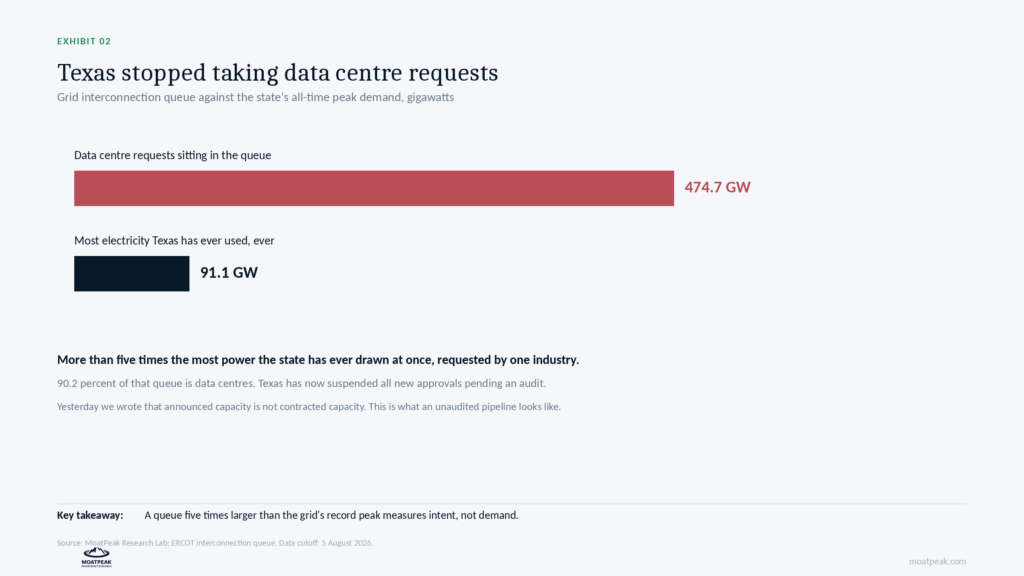
The queue of requests to connect to the Texas grid has reached 474.7 gigawatts, and over 90 percent of these requests are from data centers.
To put this in perspective, the most electricity Texas has ever used at one time is about 91 gigawatts. That record was set on the hottest day, when every air conditioner in the state was running.
So, the current requests in the queue are more than five times the state’s all-time peak demand, and they come from just one industry.
That number doesn’t seem realistic, so the real question is why it exists in the first place.
This happens because it costs almost nothing to submit a request. Developers often send the same project to several utilities to find the best terms and fastest connection, so each utility adds the request to its own queue. That means one project can show up three or four times in the system. Some requests are just speculative, hoping to get a spot in line and find funding later. Others won’t commit to paying for the grid upgrade they want, which usually shows how serious they are.
None of this is fraud. It’s just what happens when it’s free to join a queue and having a spot is valuable. Number is a measure of intent rather than demand, and the two look identical when quoted in a press release or a market size estimate. Somebody will take 474.7 gigawatts, multiply it by a price per megawatt, and publish a total addressable market. It will be quoted back for months.
That’s why the audit is more important than the suspension. Someone will finally sort out which requests have real money behind them and which are just hopeful.
To be fair, this doesn’t mean data center demand is fake. It’s obviously huge and still growing, and the companies actually building are showing results that prove it. The point is that the pipeline number everyone quotes isn’t the real size of that demand, and the difference is big.
What does this mean for you? Whenever you hear a big number during a boom, ask what it cost the person to say it: a signed contract with collateral costs something. A spot in a free queue costs nothing. Only the first is real evidence, and the free one is usually the bigger number, which is why it spreads so far.
We believe the real contracted capacity is covered in today’s Compass.
Read it at https://moatpeak.com
Educational research only. Not personalized investment advice. MB “MoatPeak Group”.
Get the Weekly Explainer
The biggest market story explained, every week. Free, by email.
Explore the research library
Company, industry and market reports with sources, charts, possible outcomes and the full evidence.
More free explainers
Markets, companies, portfolio basics and investing foundations. All free articles.
Back to Learn