

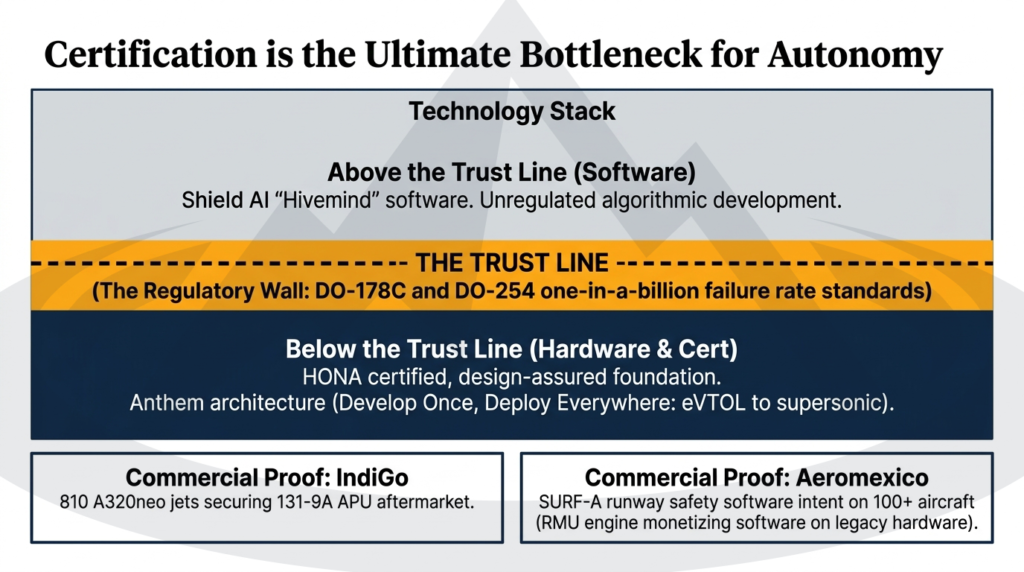
This week, Shield AI, a leading name in defense artificial intelligence, signed an agreement with a company that makes cockpit boxes, brakes, and tail engines. At first, this partnership might seem unusual. But it’s actually the most important lesson in AI this week, and it highlights something the market often misunderstands.
Here’s Shield AI’s challenge. You can create great flight software in a garage, but you can’t actually fly it. Regulators require proof that the system fails less than about once in a billion hours of use before it can carry people. Gathering this proof takes years of testing and paperwork, and it’s a slow, tedious process. This work can add 25% to 40% to the cost of developing the software, and very few companies have the experience to handle it.
Honeywell Aerospace has that experience. So, this deal divides the roles clearly: the fast-moving AI company provides the brains, while the established hardware company provides the approval.
Now, compare this to the rest of the AI market. Investors are paying high prices for algorithms, but almost ignoring the certified layer that determines if those algorithms can actually be used. In aviation, permission is the rare asset, not intelligence. We believe this is true in other fields too, like medicine, banking, and self-driving cars, anywhere a regulator stands between software and the customer. The gatekeeper often captures more value than the model itself, and the gatekeeper is usually the less expensive stock.
Now for some honesty: we want you to hear it from us first. The agreement doesn’t mention money, aircraft, or exclusivity. It’s just a memorandum of understanding, which is really just a handshake. In aerospace, these handshakes often fade away. So instead of celebrating, we set a specific date. If nothing is signed and funded by then, we’ll consider this story over and say so publicly.
What does this mean for you? Next time you read about an AI deal, ask who needs permission from whom. Follow the permission, because that’s usually where the lasting profits are, and it’s often the less expensive part of the business.
You can find the date we’ve set, along with the twelve questions we want management to answer on August 5, in our Special Edition report at https://moatpeak.com.
Educational research only. Not personalised investment advice. MB “MoatPeak Group”.
Get the Weekly Explainer
The biggest market story explained, every week. Free, by email.
Explore the research library
Company, industry and market reports with sources, charts, possible outcomes and the full evidence.
More free explainers
Markets, companies, portfolio basics and investing foundations. All free articles.
Back to Learn