

They say Nvidia invests in AI companies, those companies buy Nvidia’s chips, and the revenue is basically Nvidia’s own money coming back.
Let’s clear this up. Last quarter, Nvidia brought in $81.6 billion in revenue and had $48.6 billion in free cash flow. That’s real money, and it’s not something you can fake for long.
So, the sceptics are off about the revenue. But there’s another detail that many people miss.
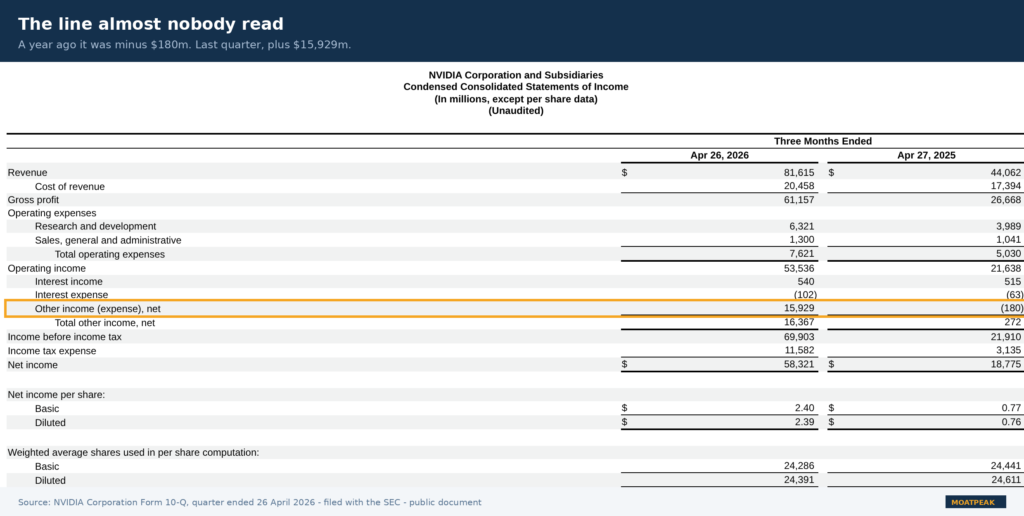
Nvidia has a line called other income. A year ago, it showed a loss of $180 million. Last quarter, it turned into a gain of $15.9 billion.
That money didn’t come from selling chips. Most of it came from Nvidia’s investments in AI companies increasing in value. Its tradeable shares went from about $13 billion to $30 billion in just one quarter.
Here’s a clear example from Nvidia. On its cash flow statement, the company subtracts that $15.9 billion right back out. Companies do this for anything that increases profit without bringing in cash. It’s just a number on a spreadsheet, not real money in the bank.
This isn’t a criticism. It’s standard accounting, done properly and shared openly. But here’s what it means: when the value of AI companies rises, Nvidia’s reported profit goes up too, even if it doesn’t sell more chips.
You can see this in two numbers. Operating income, which is profit from Nvidia’s main business, grew 147%. Net income, which is the number most people look at, grew 211%. Most of that difference comes from what we just discussed.
And of course, it can go both ways.
There’s something else to point out. Over the same twelve months, two of the most visible companies in Nvidia’s financing circle, Oracle and CoreWeave, dropped about 52% and 39%. So while the public market has been marking this theme down, this particular line marked it up. We don’t have the full details for each holding, and we won’t pretend we http://do.it means for you: when profit grows much faster than sales, find out why before you celebrate. Sometimes it’s genuine operating leverage, which is excellent. Sometimes it’s the value of the company’s assets being marked up, which is real but far more fragile. They look identical on the headline. They behave nothing alike in a downturn. The cash flow statement is where you check; it takes about 30 seconds. This week’s report explains which part of the profit is from operations and which part is from investments.rt.
Read more of this at https://moatpeak.com
Educational research only. Not personalised investment advice. MB “MoatPeak Group”.
Get the Weekly Explainer
The biggest market story explained, every week. Free, by email.
Explore the research library
Company, industry and market reports with sources, charts, possible outcomes and the full evidence.
More free explainers
Markets, companies, portfolio basics and investing foundations. All free articles.
Back to Learn