

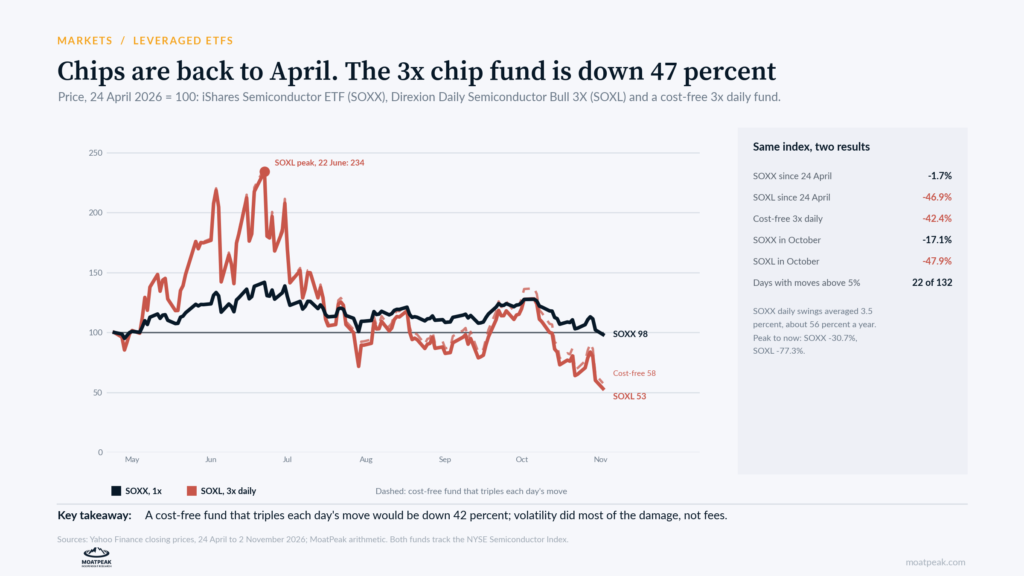
On 2 November, the iShares Semiconductor ETF (SOXX) closed 1.7 percent below its level of 24 April. Over the same span, SOXL, which seeks three times the same index’s daily move, lost 46.9 percent.
Fees explain little of the gap. A cost-free fund that tripled each day’s move would have lost 42.4 percent. The rest of the damage came from volatility. SOXX moved more than 5 percent on 22 of those 132 trading days, and its daily volatility was 3.5 percent, about 56 percent a year.
The arithmetic is simple. After a 10 percent fall, the index needs an 11 percent gain to get back. A 3x fund that fell 30 percent needs 43 percent, and three times 11 is only 33. Each round trip leaves the leveraged fund lower.
The Nasdaq version shows the same pattern, but with lower volatility. QQQ ended 2 November where it was on 5 May, while TQQQ, its 3x daily twin, was down 11.8 percent.
Our read: a 3x daily fund is built for holding periods of days. Held for months through a market this choppy, it can lose half its value while the index goes nowhere.
Research, not advice.
Get the Weekly Explainer
The biggest market story explained, every week. Free, by email.
Explore the research library
Company, industry and market reports with sources, charts, possible outcomes and the full evidence.
More free explainers
Markets, companies, portfolio basics and investing foundations. All free articles.
Back to Learn