

Bond investors will read every line of the Treasury’s refunding statement on 4 November. Meanwhile, a stablecoin company has become a large holder of the bills the Treasury sells.
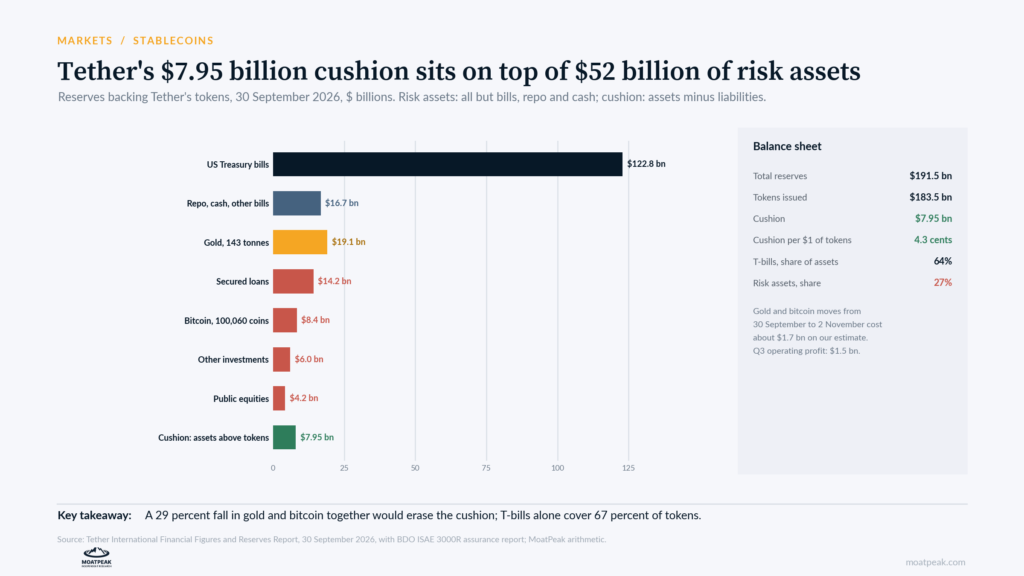
At the end of September, Tether held $122.8 billion of Treasury bills directly, 64 percent of its $191.5 billion of reserves. It also held $16.7 billion of repo, cash and other bills. The bills alone cover 67 cents of every dollar of tokens it has issued.
The rest of the balance sheet is where the risk sits: $19.1 billion of gold (143 tonnes), $14.2 billion of secured loans, $8.4 billion of bitcoin (about 100,000 coins), $6.0 billion of other investments and $4.2 billion of listed equities. That totals $52 billion.
Tether’s assets exceed its liabilities by $7.95 billion, or 4.3 cents per token dollar. A 29 percent fall in gold and bitcoin together would erase that cushion. By our estimate, their price moves from 30 September to 2 November cost about $1.7 billion, more than the $1.5 billion of operating profit Tether earned in the whole third quarter.
Our read: as long as tokens in circulation hold near $184 billion, Tether stays a large and steady buyer of bills. Its cushion, though, now moves with gold and bitcoin.
Research, not advice.
Get the Weekly Explainer
The biggest market story explained, every week. Free, by email.
Explore the research library
Company, industry and market reports with sources, charts, possible outcomes and the full evidence.
More free explainers
Markets, companies, portfolio basics and investing foundations. All free articles.
Back to Learn