

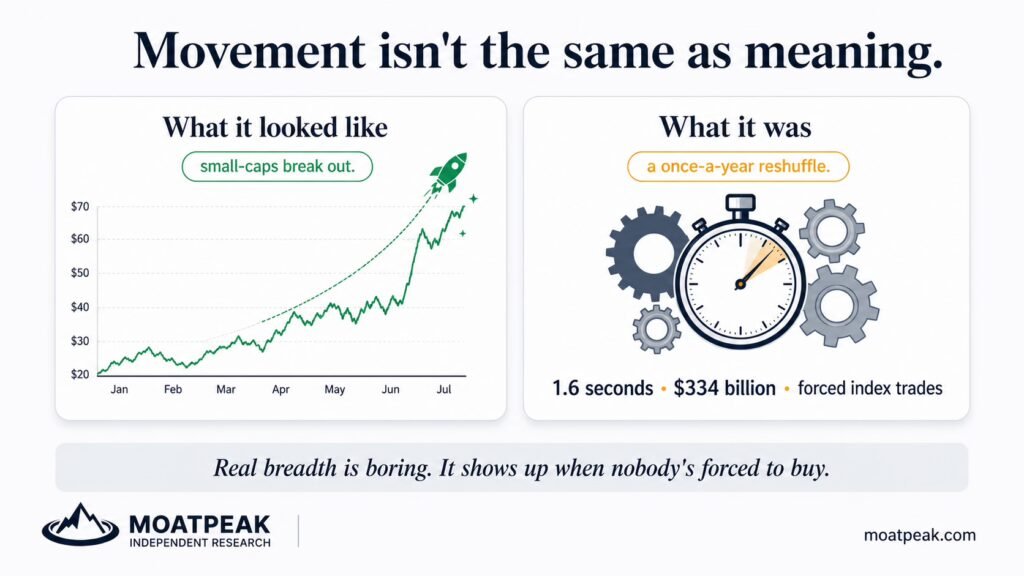
Here’s a small market mystery from last week. The Russell 2000, the index of smaller US companies, pushed above a big round number and looked, for a moment, like proof the rally was finally broadening out beyond a handful of giant tech names. More stocks joining in is supposed to be a healthy sign. Then you look at how it happened, and the story falls apart.
Late last Friday, in a single burst lasting about a second and a half, the exchange processed a record $334 billion of trades at once. That wasn’t a wave of investors deciding small-caps were cheap. It was the Russell “reconstitution,” the once-a-year housekeeping where the index rebuilds its membership list and every fund that tracks it has to buy and sell the same names at the same instant to keep up. Mechanical. Forced. Nothing to do with conviction.
It’s worth filing away, because it’s a trap that catches people constantly: mistaking movement for meaning. A price can lurch on flows that hold no opinion at all: index rebalances, options expiries, end-of-quarter tidying. It looks like a crowd voting, and it’s really just plumbing. The tell is whether the move sticks once the forced trading is done. So when you see a dramatic “breakout” on a day you later learn was an index reshuffle, hold your applause. Real breadth turns up the boring way: lots of ordinary companies drifting higher on ordinary days, with nobody forced to buy them. Whether last week’s small-cap strength was the real thing or just plumbing is exactly what we’re watching now at https://moatpeak.com.
Get the Weekly Explainer
The biggest market story explained, every week. Free, by email.
Read the complete Member report
Sources, charts, possible outcomes and the full evidence behind this article.
Then $19/month. Cancel online before the trial ends.
More free explainers
Markets, companies, portfolio basics and investing foundations. All free articles.
Back to Learn