

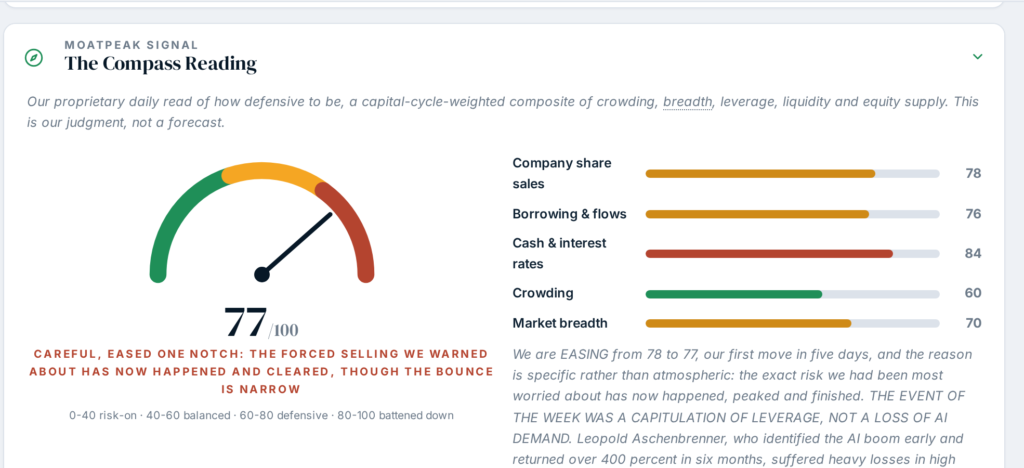
This is the analysis we disagree with most strongly this week.
Most people now believe the recent selloff shows the AI trend was overhyped and that the bubble is bursting. We disagree. If you misread the situation, you are likely to make the wrong move.
Let’s look at what was actually forced out of the market.
In Korea, leveraged fund assets dropped from about 50 billion dollars to 16 billion. Around 700,000 retail traders exited the market. Even a well-known fund that correctly bet on AI failed because it borrowed too much, and one bad month led to a margin call.
This does not reflect a lack of demand. It reflects too much debt.
Now consider the fundamentals during the same period, which most reports ignored. Memory prices are going up. Samsung reported record profits and expects a shortage until 2028. Spending by large tech companies is increasing, not decreasing. Microsoft’s cloud business grew 43 percent, with over 30 million people paying for its AI assistant. Amazon’s cloud business grew 37 percent, with margins close to 40 percent.
Two out of the four major companies turned their spending into real revenue. That is not an illusion.
Here’s what convinced us. As soon as the forced sellers were gone, the market rebounded. Momentum stocks had their biggest single-day gain since 2003. The Korean market rose 16 percent.
That is not how bubbles behave. When a bubble bursts, buyers do not return right after margin calls end, because people have lost faith in the story. When a period of forced selling ends, prices bounce back because the underlying reasons remain the same. Only the owners have changed.
This is not a signal to buy everything. Two of the four big companies showed strong results. One did not: Meta’s cash reserves dropped from about 8.6 billion dollars to under 1 billion, a fall of about 91 percent, with spending set to rise and no clear goals. It no longer makes sense to treat all the big tech companies as one group.
What does this mean for you? When prices drop sharply, ask yourself two questions that often get mixed up. Did the story change, or did the ownership change? If the story changed, it may be time to rethink your position. If only the ownership changed because forced sellers left, it is often a different situation.
You can find out which big companies we still support, which ones we are moving away from, and what could change our view in today’s Compass.
Read it at https://moatpeak.com
Educational research only. Not personalised investment advice. MB “MoatPeak Group”.
Get the Weekly Explainer
The biggest market story explained, every week. Free, by email.
Read the complete Member report
Sources, charts, possible outcomes and the full evidence behind this article.
Then $19/month. Cancel online before the trial ends.
More free explainers
Markets, companies, portfolio basics and investing foundations. All free articles.
Back to Learn