

For several weeks, we have said that Apple is the simplest way to invest in big tech, since it avoids the huge capital spending that is hurting other companies.
This week, we are adjusting that view ourselves instead of waiting for someone else to point out the need for a change.
Apple did well overall, but it fell short in two key areas. Its services business, which has the highest profit margins, missed expectations by almost a billion dollars. Sales in China and Japan were also weaker than expected.
The problem was with our reasoning, not with the news itself.
We assumed that avoiding one risk meant Apple was completely safe.
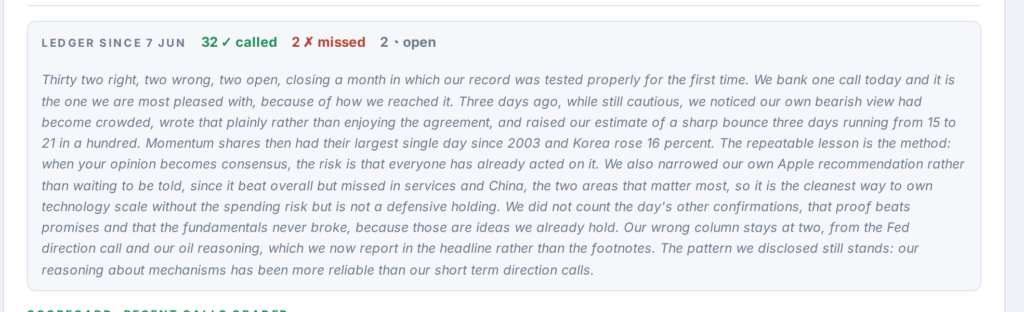
But those are not the same. Apple does avoid the spending race, which is a real advantage. However, it still sells devices in a slowing Chinese market, faces higher memory chip costs, and its most profitable business is slowing down. So, it traded one risk for another instead of getting rid of risk altogether.
To clarify, Apple is still the simplest way to invest in large tech companies without the capital spending risk. But it is not a defensive stock. We had mixed up those two ideas, and they should be kept separate.
Since June, we have made 32 calls, missed 2, and have 2 still open. The two misses were about interest rates and our thinking on oil. We mention these up front, not hidden in the footnotes. Our track record shows that our reasoning about how things work has been more reliable than our short-term predictions.
We are sharing this not out of modesty, but for a specific reason.
If you cannot check research, it is pure entertainment. If a publication never admits to mistakes, it is not because they never make them, but because they are not showing you everything. You should only trust our next call because you can see what happened with the last thirty-six.
Three days ago, even though we were still cautious, we noticed something uncomfortable: our own negative outlook had become common.
Professional investors had reduced their tech holdings to very low levels. Hedging was costly, and everything we read sounded negative.
Instead of feeling reassured by this agreement, we took it as a warning and made a note of it. Over the next three days, we increased our estimate of a sharp rebound from 15 to 21 out of 100, but we still recommended patience instead of aggressive action.
The rebound happened. Momentum stocks had their biggest single day since 2003, and Korea’s market rose by 16 percent.
The main lesson is to focus on the method, not just the outcome. When your view becomes the consensus, the risk is that everyone has already acted, leaving no one to move prices further in your favor.
Now for the part that matters more to us, and it is why we are not celebrating.
On the same day that the main index went up, the equal-weighted index actually fell.
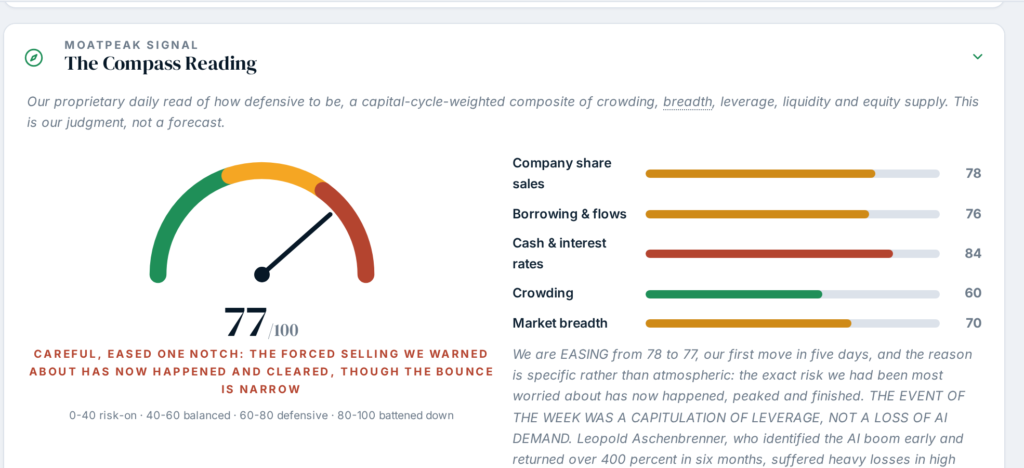
Let us explain: the main index is heavily influenced by a few huge companies, while the equal-weighted index treats every company the same. If the main index rises but the equal-weighted one falls, it means only a few big companies drove the gains, while most others lost ground.
This kind of split is rare, and research studies it to a few unique cases from the year 2000.
A rally caused by short sellers closing their positions is not the same as real buyers coming in with confidence. The first is mechanical and ends quickly, while the second builds over time.
So, we became slightly less cautious, lowering our caution rating from 78 to 77. This was our first change in five days, and we did it for a clear reason: the risk we were most concerned about happened, peaked, and ended. It does not mean everything is safe now.
What does this mean for you? After any big rally, check if it was widespread or limited to a few companies before making decisions. If most companies did not take part, it is likely just a short squeeze, not a real recovery. This quick check can protect you from costly mistakes.
We need to see two things happen at the same time before we can call this a real recovery. Both are listed in today’s Compass, along with what could make us change our view.
Read it free at https://moatpeak.com
Educational research only. Not personalised investment advice. MB “MoatPeak Group”.
Get the Weekly Explainer
The biggest market story explained, every week. Free, by email.
Explore the research library
Company, industry and market reports with sources, charts, possible outcomes and the full evidence.
More free explainers
Markets, companies, portfolio basics and investing foundations. All free articles.
Back to Learn