

We still stand by that view.
Today, new evidence gave us a perspective, and we want to share this update openly.
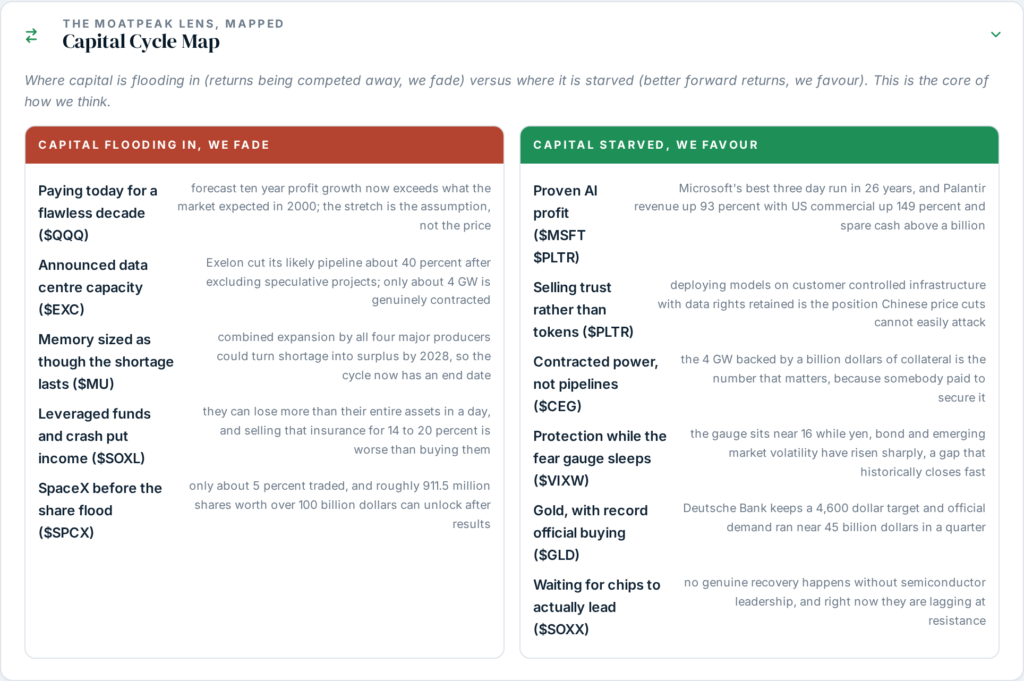
Exelon, a major American power company, reviewed its data centre pipeline and reduced it by about 40 percent. The demand it sees as likely dropped from around 18 gigawatts to 11, and its total pipeline went from 43 gigawatts to 25.
Nothing colNothing drastic happened. Demand is still there. They just removed the projects that were speculative, which is where things get interesting. Examined the pipeline closely, a large portion of announced data centers turned out to be duplicates. The same project counted more than once, because developers shop a single site around several utilities to see who offers the best terms. Every one of those utilities books it as demand. One project, several times, in several pipelines.
Some projects had no funding. Others would not commit to paying for the grid connection they wanted, which is usually a good sign of how serious they are.
So, how much capacity was actually contracted? About 4 gigawatts, backed by a billion dollars in collateral.
That’s 4 gigawatts, compared to the 43 that were announced. 4 is the number that means something, because somebody put money at risk to secure it. Everything else is intention, and intention is free.
The updated rule is simple: focus on contracted capacity, not just what’s been announced.
This idea applies to much more than just power stations, which is why we think it deserves a full discussion, not just a footnote.
Every boom leads to a flood of announcements. Announcements are free. They attract investors, move share prices, and get included in market size estimates, which are then used as proof of how big the opportunity is. Numbers from press releases often get treated as real. The test is always the same and always available. Ask who has put up collateral. Ask what has actually been signed, not just talked about. Only money that has already changed hands shows real http://commitment.in in it.
Capacity is still the main constraint, and the contracted 4 gigawatts are real and paid for. We see that what changes is how we measure and choose, focusing more on power producers with signed private contracts instead of those just quoting big pipelines.
We share these corrections as soon as we find them, because a research service that only confirms its own views is not giving you real value.
What it means for you. Whenever you see a big number about future demand, ask one question first: is it contracted or just announced? The difference between those two is where a lot of money can be lost, and you can usually find the answer for free in a company filing.
Read it at https://moatpeak.com
Educational research only. Not personalised investment advice. MB “MoatPeak Group”.
Get the Weekly Explainer
The biggest market story explained, every week. Free, by email.
Read the complete Member report
Sources, charts, possible outcomes and the full evidence behind this article.
Then $19/month. Cancel online before the trial ends.
More free explainers
Markets, companies, portfolio basics and investing foundations. All free articles.
Back to Learn